Loading lesson…
Decomposition
20 min read
Decomposition means breaking a task into stages, where each stage produces something you can inspect before the next stage uses it. At Level 2 the point isn't just smaller prompts. It's a chain you can debug: when the final output is wrong, you can find the stage that went wrong. This module covers how to design those stages, what to pass between them, and how to settle assumptions early so they don't compound.
What you will be able to do
- Design a chain that will Pass stage outputs into later prompts in a defined, checkable form.
- Resolve underspecification and material assumptions at the first stage, before analysis depends on them.
- Specify audience, business constraints and decision criteria so each stage knows what the final output is for.
- Use a role only when perspective helps, knowing that Role framing does not confer credentials.
- Shape the final stage around Audience-specific depth and decision needs.
The idea
A single prompt that asks for research, analysis, and a recommendation hides its intermediate work. If the recommendation is wrong, you can't tell whether the facts were wrong, the analysis was wrong, or the framing was wrong. A chain makes each of those a separate, visible output.
A typical chain has three or four stages:
- Clarify. Extract requirements from the brief. List what's missing or ambiguous. List assumptions that would change the answer if wrong. Stop for a human answer.
- Gather or extract. Pull the facts needed from supplied sources into a fixed structure.
- Analyze. Apply the decision criteria to the extracted facts.
- Present. Shape the result for a specific reader.
Pass structure, not prose. Each stage should hand the next a defined output: a list of confirmed requirements, a table of extracted values, a set of scored options. Passing a long narrative forward invites the next stage to reinterpret it. Passing a structured record lets you check it against the source and lets the next prompt reference fields by name.
Settle material assumptions early. An assumption is material if changing it would change the recommendation. Contract length, user count, budget ceiling, and deadline are typical. Surface these in stage 1 and get them confirmed. An assumption buried in stage 3 is far harder to spot.
State the decision context. Every stage should know who the final reader is, what decision they're making, and what constraints apply (budget, timeline, policy, existing systems). Without that, stage 2 may extract the wrong facts and stage 3 may optimize the wrong thing.
Roles are a lens, not a license. "Review this as a procurement analyst would" can help the analysis stage weigh contract risk. It adds nothing to an extraction stage. And no role makes the output qualified advice: "act as a CPA" doesn't produce work a CPA stands behind. Use a role when a perspective changes what gets noticed, and leave it out otherwise.
Depth follows the reader. A CFO deciding whether to renew needs cost, risk, and a recommendation on one page. The IT lead implementing it needs migration steps and dependencies. Same analysis, different final stage.
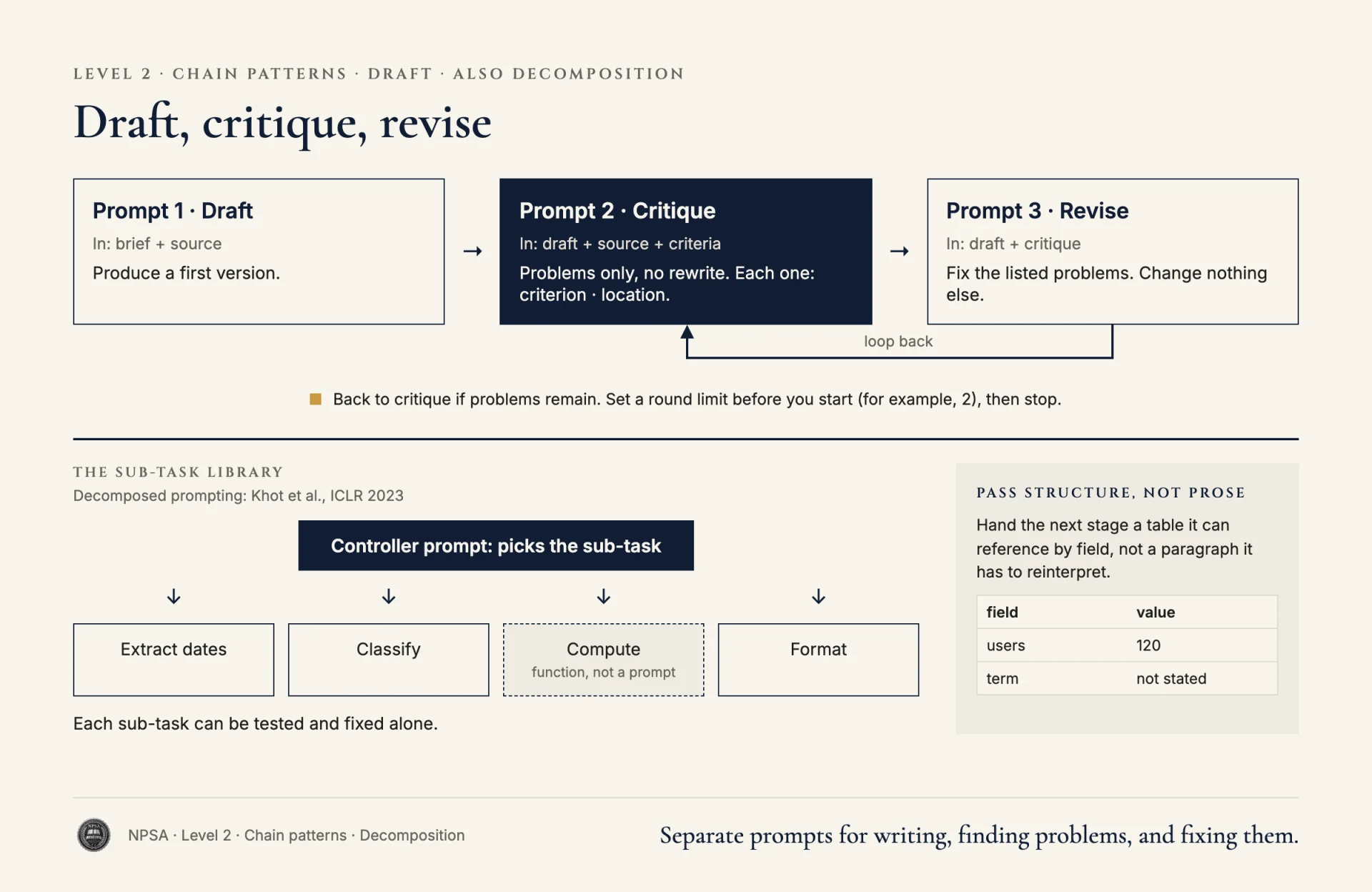
Worked example
Lena Fischer is an operations analyst at a 300-person insurance brokerage. The help desk ticketing contract renews in 60 days. Her CFO wants a renew-or-switch recommendation. She has the current contract, two competitor quotes, and 12 months of ticket volume data.
Before:
You are a senior IT consultant and CPA. Read the contract, the two
quotes, and the ticket data, and tell the CFO whether we should
renew or switch.
This prompt merges every stage, so errors are invisible. The combined role implies credentials the output doesn't have. "Tell the CFO" gives no depth or decision criteria, and nothing surfaces assumptions such as contract term or agent count.
After:
STAGE 1 of 3 - Clarify. Do not analyze yet.

Decision: renew current help desk vendor or switch, for the CFO.
Constraints: budget ceiling $60,000/year; go-live before current
contract ends on January 31; must integrate with our existing
single sign-on.

From the attached contract and quotes:
1. List each vendor's term length, per-agent price, agent count
   assumed, and implementation fee. Use "not stated" if absent.
2. List assumptions I must confirm before comparison (for example,
   agent count or term length differing between quotes).
3. List any requirement above that a document doesn't address.

Return only these three lists.
After Lena confirms the assumptions (14 agents, 3-year term), she runs stage 2 with that confirmed list pasted in as input, scoring each vendor against her stated criteria. Stage 3 takes the scored table and produces a one-page CFO memo: cost over three years, top two risks, and a recommendation.
Why this is stronger. Each stage has one job and a checkable output. The quotes assumed different agent counts, which stage 1 surfaced before it could distort the cost comparison. Stage 2 receives confirmed facts, not raw documents. The CFO memo is shaped to the reader's decision, and no stage claims expertise it doesn't have.
Try it
Setup. Pick a recommendation you might need to make: choosing a tool, a training provider, a shipping option. Gather two or three source documents, real or invented.
Task. Write a stage 1 prompt that states the decision, the reader, and two constraints, then asks only for extracted facts, assumptions to confirm, and gaps. Run it. Answer the assumptions yourself. Then write a stage 2 prompt that takes the stage 1 output as input.
What a good result looks like. Stage 1's output is short and structured, and you can check every fact against the source. At least one assumption surfaces that would have changed the answer. Stage 2 references stage 1's fields directly instead of re-reading the documents.
Recap
- Split work into stages whose outputs you can inspect.
- Pass structured records between stages, not narrative.
- Surface and confirm material assumptions in the first stage.
- State the reader, the decision, and the constraints at every stage.
- Use a role only where perspective helps. A role is never a credential.