Loading lesson…
Cost and latency budgets
20 min read
A workflow that's affordable at 50 runs a day can be expensive at 50,000, and one that answers in two seconds in testing can take twenty in production. Cost and latency are design constraints, not afterthoughts. This module shows how to decide which model each step needs, which calls are worth making at all, and how to cut tokens without cutting the controls that keep output correct.
What you will be able to do
- Choose model by required quality and total task cost, including the cost of human rework, not just the per-token price.
- Measure value of each workflow call before consolidation, so you merge or remove calls based on evidence.
- Control context and token use without redundant text, while keeping the instructions and examples that hold quality.
- Calculate monthly cost for a workflow from token counts and volume, and compare designs on that basis (Choose model by required quality and total task cost).
The idea
Total task cost, not price per token
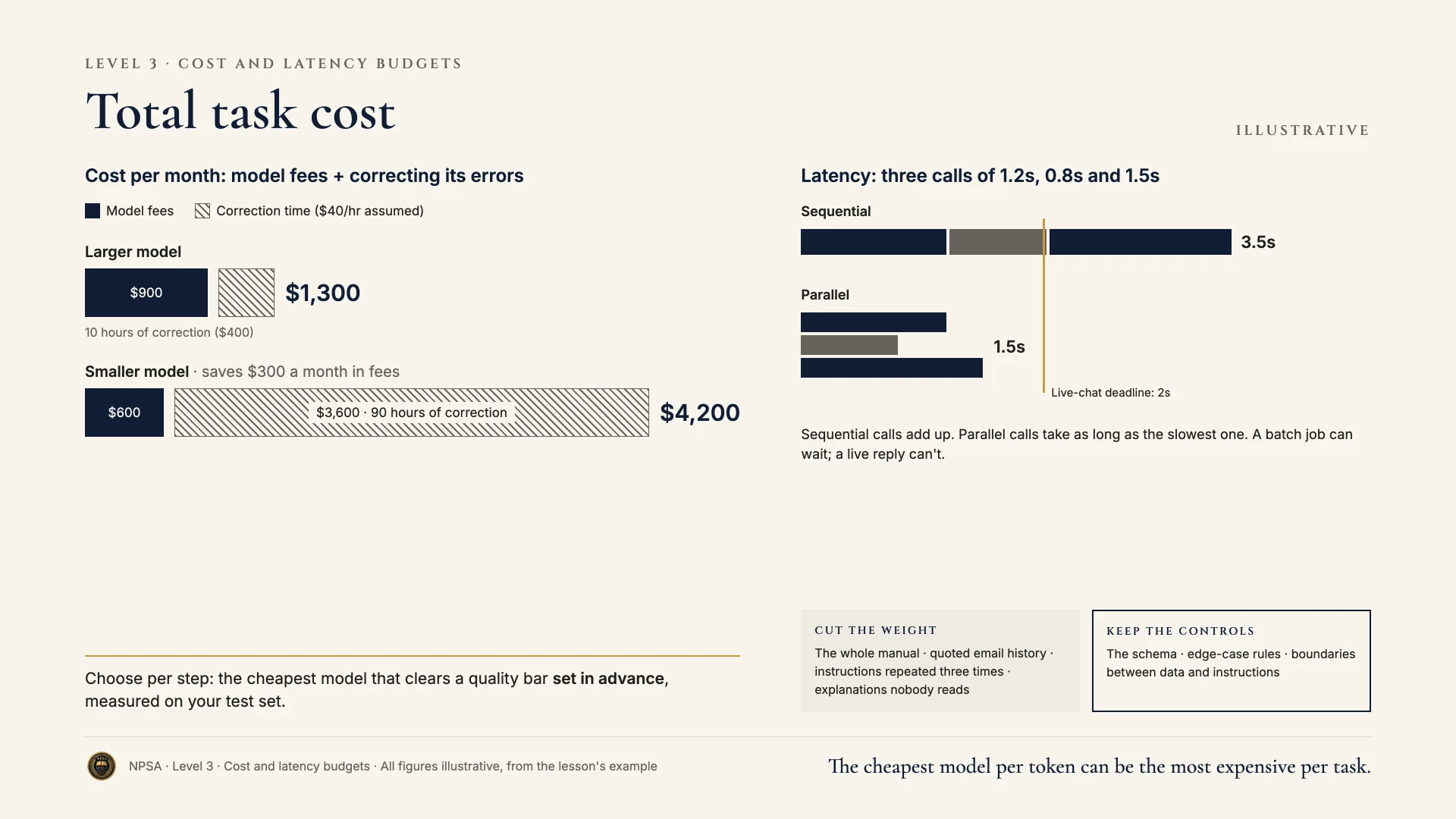
Larger models usually cost more per token and respond more slowly. Smaller models are cheaper and faster, but may miss more. The right comparison is total task cost: model cost plus the cost of the errors it produces. If a cheaper model saves $300 a month but creates 90 hours of manual correction, it's the expensive option.
So choose per step. Measure each candidate model on your test set for that step, with a quality bar defined in advance. Use the cheapest model that clears the bar. Different steps in one workflow can use different models.
Latency follows the same logic. Know the deadline that matters to the user. A background batch job can wait. A live chat reply can't. Sequential calls add their latencies together. Parallel calls don't.
Every call has to earn its place
Multi-step workflows accumulate calls. Before merging or removing any, measure what each one contributes:
- Does anyone use its output? How often?
- What happens to quality on the test set if it's removed or merged into a neighboring call?
- Does it exist for a control reason, such as validation or a safety check, that a merge would weaken?
Consolidation can save money and time. It can also hide a stage you needed to inspect. Decide with measurements.
Tokens: cut the weight, keep the controls
A token is the unit models process and providers usually bill. Common sources of waste:
- Pasting a whole manual when the task needs two sections.
- Including quoted email history the task doesn't use.
- Repeating the same instruction in three places.
- Asking for long explanations no one reads.
What not to cut: the schema, the rules that handle edge cases, the boundary examples, and the delimiters around untrusted input. Trim in small batches and rerun your regression suite after each.
Worked example
Malik Johnson runs automation for claims intake at a regional property insurer. About 20,000 claim emails arrive each month. The current workflow makes four calls per email, all on the larger model. The rates below are illustrative. Check your own provider's pricing.
- Larger model: $5.00 per million input tokens, $15.00 per million output tokens
- Smaller model: $0.50 per million input tokens, $1.50 per million output tokens
Before:
Call 1 classify claim type   1,800 in /  20 out  (larger)
Call 2 extract fields        2,500 in / 300 out  (larger)
Call 3 summarize for adjuster 2,500 in / 250 out (larger)
Call 4 draft acknowledgment  1,200 in / 200 out  (larger)
Per email: 8,000 in, 770 out = $0.0400 + $0.0116 = about $0.052
Monthly: about $1,031
Malik measured before changing anything:
- Call 1 re-reads the email that Call 2 also reads. Adding a
claim_typefield to Call 2 matched Call 1's accuracy on a 200-email holdout set. - Call 3 summaries are opened by adjusters on only 6% of claims. He makes it on-demand.
- Call 2 on the smaller model needed manual field correction on 9% of emails, versus 2% on the larger one. That's about 1,400 extra corrections a month at roughly 4 minutes each, or 93 hours of adjuster time, to save about $306. Extraction stays on the larger model.
- Call 4 acknowledgments scored the same on the smaller model against the tone and accuracy rubric. It moves.
- Stripping quoted reply history before extraction cut about 700 input tokens per email, with no change in field accuracy.
After:
Call A extract fields + claim_type  1,900 in / 320 out (larger)
       = $0.0095 + $0.0048 = $0.0143
Call B draft acknowledgment          1,200 in / 200 out (smaller)
       = $0.0006 + $0.0003 = $0.0009
Call C summary, on demand (6%)       avg $0.0010 per email
Per email: about $0.0162
Monthly: about $324
Holdout field accuracy: unchanged at 98%.
Why this is stronger. Each change was measured before it shipped. The model for extraction was chosen on total cost, including adjuster time, not on token price. The removed calls had no measurable value. Tokens were cut from content the task didn't use, while the schema and validation stayed intact. Fewer sequential calls should also cut response time, which Malik confirms in the pilot.
Try it
Setup. Pick a workflow you run or could run with two or three AI calls. In a spreadsheet, list each call with estimated input and output tokens. (A rough guide: 1,000 English words is often around 1,300 tokens. Your tool may show exact counts.)
Task. Pick illustrative per-million-token rates for a larger and smaller model. Calculate cost per run and per month at a volume you choose. Then, for each call, write one sentence on what it contributes and what would break without it. Propose one change and estimate its saving.
What a good result looks like. Your spreadsheet shows the formula for each cost cell. Each call has a stated purpose. Your proposed change includes what you'd measure to confirm quality holds before shipping it.
Recap
- Compare models on total task cost, including human rework.
- Choose a model per step, using a quality bar defined in advance.
- Measure each call's value before merging or removing it.
- Cut unused context and repeated text, not schemas, rules, or boundaries.
- Rerun your regression suite after every cost change.