Loading lesson…
Porting across models
20 min read
Sooner or later every production system changes models: a provider retires a version, a cheaper option appears, or a new capability becomes worth having. Moving a prompt to a new model is a migration, not a copy-paste. This module covers three linked skills: choosing the simplest architecture that meets the need, proving a prompt still works after the move, and migrating the many copies of a prompt that tend to accumulate across an organization.
What you will be able to do
- Choose the Simplest adequate architecture and measured model routing for a task, and justify it with test results.
- Route requests between models based on measured performance, not assumptions (Simplest adequate architecture and measured model routing).
- Test Paraphrase robustness, targeted repair and regression tests after a model change.
- Inventory and migrate shared prompts with legitimate variants without erasing real local requirements.
The idea
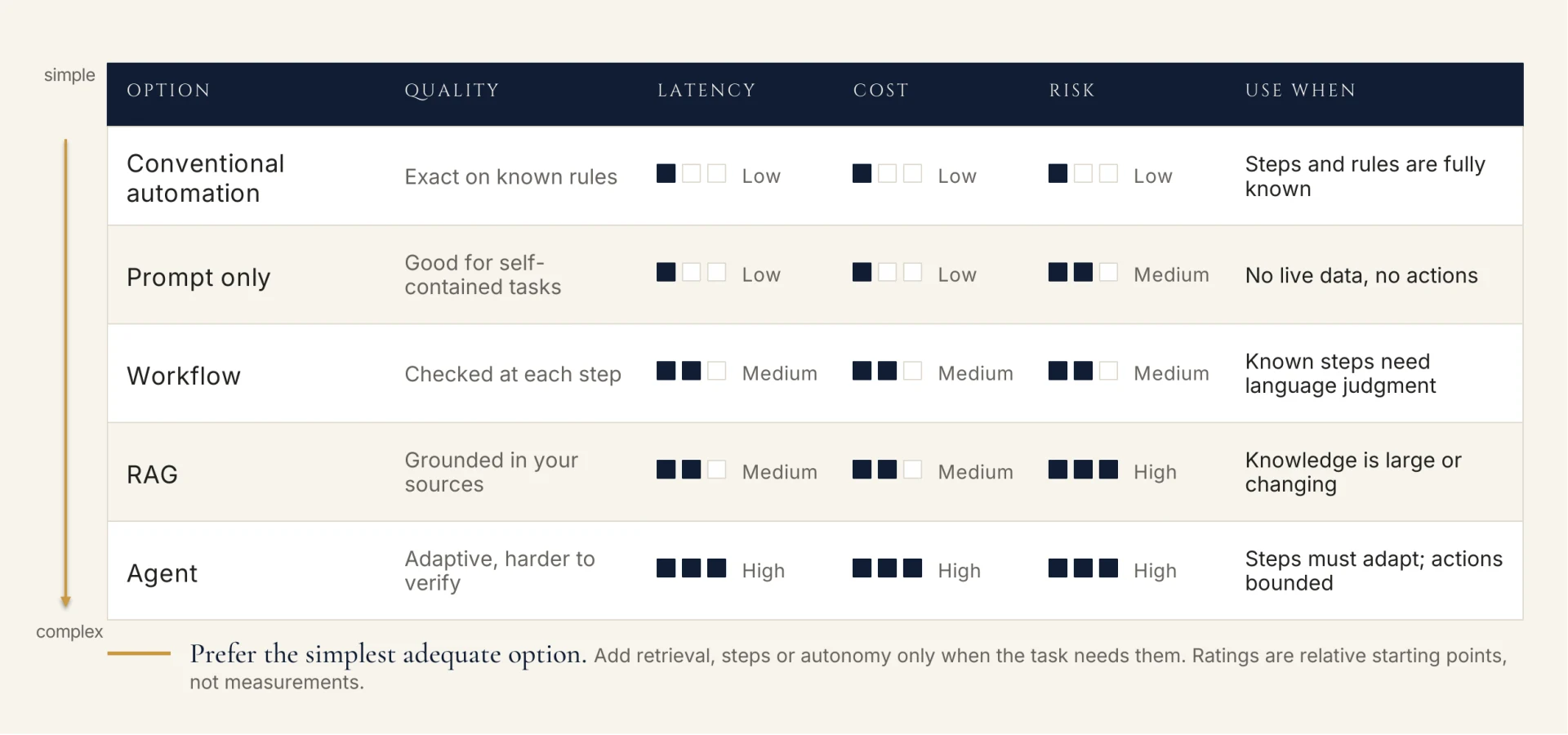
Start simple and add only what you can measure
Architecture options run from simple to complex:
- A single prompt to one model.
- A prompt plus retrieved documents (RAG).
- A chain of prompts with validation between stages.
- An agent that chooses tools and steps.
- A fine-tuned or custom model.
Each step up adds cost, latency, failure points, and maintenance. Move up only when the simpler option fails a defined quality bar on your test set. A team that builds an agent for a task a single prompt can handle has created risk with no measured benefit.
Routing sends different requests to different models. Simple, high-volume requests may go to a smaller, cheaper model. Complex or high-risk ones go to a larger one. The routing rule must be based on measured performance per request type, and it needs its own tests: a misrouted complex request is a quality failure.
Prove behavior survives the move
Models differ in how they weight instructions, format output, handle long context, and refuse. A prompt tuned on one model is an untested hypothesis on another. Before switching:
- Run your full regression suite on the new model with settings recorded.
- Add paraphrases of key test cases: the same request worded five different ways, with typos, fragments, and different orders. Robustness means behavior holds across wordings, not just on the exact text you tuned on.
- When something fails, diagnose the specific cause, such as instruction placement, an example the new model over-copies, or a format it parses differently. Make a targeted repair, then rerun the whole suite. Broad rewrites to fix one failure usually break others.
Migrate the copies, not just the master
Popular prompts get copied. Over a year, a single prompt may exist in eight versions across teams, each with small edits. Some edits are drift. Some are legitimate: a branch that must include a regional code, a team that needs a different output field. A migration that replaces everything with one "clean" version will break the legitimate ones.
So inventory first: find every copy, its owner, its consumers, and what it does differently. Separate legitimate variants (documented, needed) from drift (undocumented, accidental). Build a shared core with documented parameters for real variants. Migrate in risk order, test each branch's outputs old versus new, and retire old copies only after their consumers have moved.
Worked example
Rosa Delgado leads AI enablement at a regional bank's contact centers. A call-summary prompt runs in nine copies across three centers and two business lines. The current model is being retired in 90 days. One team proposes rebuilding the whole thing as an agent on the newest large model "to future-proof it."
Weak approach. Build the agent, copy the most recent prompt version into it, and switch all nine copies on the retirement date.
Better approach. Rosa runs the migration as a measured project.
Before:
Rebuild call summaries as an agent on the new large model. Use the
newest prompt copy for everyone. Switch on retirement date.
After:
1. Architecture: test single prompt on new small model and new large
   model against the 300-call regression suite. Small model meets
   the quality bar on 94% of call types; fails on complaint calls
   with regulatory language.
   Decision: single prompt, routed. Small model by default; large
   model for calls tagged complaint or regulatory. No agent.
2. Robustness: add 5 paraphrase variants for 40 key cases. Small
   model drops the "next action" field when agents speak in
   fragments. Targeted repair: move field rules after the
   transcript. Full suite rerun: pass.
3. Inventory: 9 copies found, 9 owners. 2 legitimate variants
   (mortgage line needs loan_stage; Center C needs Spanish-language
   flag). 7 differences are drift.
   Shared core v1 + 2 documented parameters.
4. Migration: Center A (week 1), B (week 3), C (week 5). Old vs new
   outputs compared on 50 calls per branch. Old copies retired after
   logs show zero calls for 14 days.
Why this is stronger. The architecture is the simplest one that passed the tests, with routing justified by measured failures. Robustness was tested on paraphrases, and the repair targeted one cause. The inventory protected two real requirements and removed seven accidental ones. Retirement was verified, not assumed.
Try it
Setup. Pick a prompt you use. If you have two different chat models or model sizes available, use both. If you only have one, use that.
Task. Write 6 test inputs, then write 2 paraphrases of each, for 18 total. Run all 18 on each model you have and record whether each output meets your quality bar. Identify any input that fails across paraphrases.
What a good result looks like. You have a pass/fail grid across all 18 inputs. You've named a specific cause for at least one failure rather than just "the model was worse." If you ran two models, you can also say which model is adequate for which input types.
Recap
- Use the simplest architecture that clears your quality bar, and add complexity only with evidence.
- Route between models based on measured performance per request type.
- Treat a model change as a migration: rerun the suite, test paraphrases, make targeted repairs.
- Inventory every copy, keep legitimate variants as documented parameters, and drop drift.
- Migrate in stages and retire old copies only after confirming no one uses them.