Loading lesson…
Structured pipelines and branching search
25 min read
At Level 4 you decide how much of a workflow a model should generate freely and how much should be fixed in advance. This module covers two results that pull in different directions. One shows that constraining generation with templates makes automated pipelines far more reliable. The other shows that letting a model explore and evaluate several paths can solve problems a single pass can't, at a steep cost. Knowing both lets you choose the least freedom that does the job.
What you will be able to do
- Compare direct, staged, template-guided, and template-based generation for a pipeline, using published reliability figures.
- Design a step where a model fills a validated structure and fixed code does the assembly.
- Describe branching search (Tree of Thoughts), state what it achieved and what it costs.
- Decide which approach fits a task, and what evidence you'd need before adding freedom.
The idea
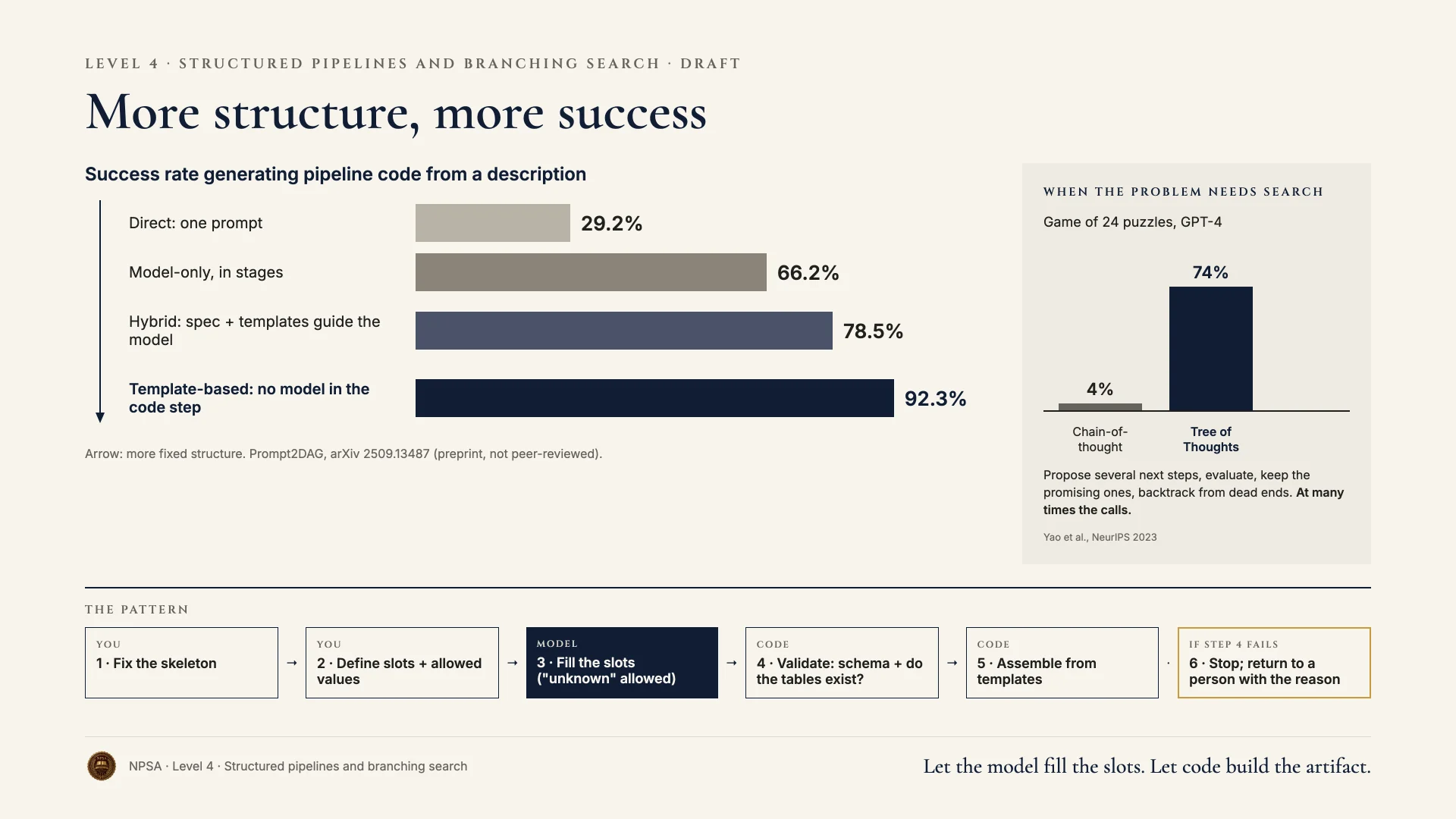
The reliability gap. Alidu, Ciavotta, and De Paoli (2025) studied how to turn a plain-language description of a data pipeline into a working, scheduled pipeline. They compared four approaches across 260 experiments, 13 models, and five case studies:
- Direct: one prompt goes from the description straight to pipeline code. 29.2% of attempts succeeded.
- Model-only, in stages: the model first turns the request into a structured specification, then writes the code from that specification in chained prompts. 66.2% succeeded.
- Hybrid: the same specification, with the model writing the code guided by templates and examples. 78.5% succeeded.
- Template-based: the same specification, expanded into code by fixed templates, with no model in the code-writing step. 92.3% succeeded.
The authors name the hybrid as the best of the approaches in which a model writes the code, and report it was more than twice as efficient as direct prompting per successful pipeline. This is a preprint and covers one kind of task, so treat the exact figures with care. The direction is the lesson: each step that took freedom away from the model raised reliability.
The trade. Templates only produce what someone anticipated. A request outside the templates fails or has to go to a person. The hybrid gives up some reliability to handle more variety. Which one you want depends on how varied your requests are and what a failure costs.
Why constraint wins. A model asked to write a whole pipeline must get the task logic right and also every detail of structure, naming, and syntax. Each is a chance to fail. In the constrained designs, the model does what it's good at: reading a messy request and producing a structured description of what is wanted. Fixed, tested code does what must be exact. The model's output is small, has a defined shape, and can be validated before anything runs.
The pattern in general.
- Fix the skeleton. Decide the stages and their order in advance. They don't vary by request.
- Define the slots. For each stage, list the parameters that do vary, with allowed values.
- Have the model fill the slots as a structured record, with "unknown" allowed.
- Validate the record against the schema and against reality: do the named tables and columns exist?
- Assemble with code. Templates turn a valid record into the artifact.
- Stop on an invalid record. Return it to a person with the reason. Don't ask the model to try again indefinitely.
The pattern applies well beyond data pipelines: report generation, document assembly, ticket routing, configuration.
Branching search. Yao and colleagues (2023) went the other way for a different class of problem. In Tree of Thoughts, the model proposes several possible next steps, evaluates each, continues from the promising ones, and backtracks from dead ends. On Game of 24, a puzzle that requires combining four numbers to reach 24, GPT-4 with chain-of-thought prompting solved 4% of cases. With Tree of Thoughts it solved 74%.
What that result does and doesn't mean. The puzzle has features most business tasks lack: many possible paths, early choices that can't be repaired later, and partial states that can be judged as promising or hopeless. Where a task has those features, such as planning under hard constraints, exploration can pay. It costs many times the calls of a single pass, and it needs a reliable way to evaluate a partial result. If the evaluation is weak, the search confidently explores the wrong branch.
A practical middle. You rarely need full search. A cheaper version: generate three candidate plans, score each against written criteria in a separate prompt, and carry the best one forward. That gives some of the benefit of exploring alternatives at three or four calls instead of dozens.
Choosing. Start from the most constrained design that could work.
- If the output must run or be parsed, constrain it: templates and a validated record.
- If the path is fixed and steps need inspecting, use a staged chain.
- If early choices are hard to undo and partial results can be scored, consider candidates-and-select, and full search only with evidence.
Add freedom only when a test on representative cases shows the constrained design fails and the freer one passes, and report the cost per successful task alongside the pass rate.
Worked example
Rafael Dominguez leads analytics for a regional grocery chain with 62 stores. Store managers ask for recurring reports in plain language: "Every Monday, send me last week's shrink by department, flagged if it's over 4%." His team wants requests turned into scheduled reports without an analyst hand-building each one.
Before:
You are a senior data engineer. Write a complete, production-ready
scheduled pipeline that fulfills this request from a store manager.
Include extraction, transformation, the report, and scheduling.

Request: [manager's message]
The model must invent table names, write query logic, choose a schedule format, and structure the whole job, all correctly, in one pass. When it fails, the failure could be anywhere. Nothing is validated before code exists.
After:
Turn a store manager's report request into a report specification.
Do not write code. Fixed templates build the report from your
specification.

Return a JSON object with exactly these fields:
- metric: one of ["shrink_pct", "sales", "units", "waste_lbs"]
- group_by: one of ["department", "category", "store"]
- period: one of ["prior_week", "prior_month", "month_to_date"]
- stores: a list of store numbers, or "requester_store"
- threshold: an object {"field", "operator", "value"}, or null
- schedule: {"day": Mon to Sun, "hour": 0 to 23}
- unclear: a list of anything in the request you could not map
  to the fields above. Use [] if nothing is unclear.

Use only the listed values. If the request asks for something
the fields can't express, put it in "unclear" and set the
affected field to null. Do not guess.

Request: [manager's message]
The record is checked against the schema, and store numbers are checked against the requester's permissions. A valid record goes to tested templates that build the query, the report, and the schedule. A record with anything in "unclear" or a null field goes to an analyst. Rafael's team runs 120 past requests through both designs and reports, for each, the share that produced a correct report without analyst rework and the cost per correct report.
Why this is stronger. The model's job shrank to the part that needs language understanding. Everything that must be exact is fixed code that was tested once. An invalid or incomplete record is caught before anything is built, and the "unclear" field gives the model an honest way to say a request doesn't fit. The comparison is on real requests, with cost counted.
Try it
Setup. Pick a recurring request your team handles in a standard way: a report, a status update, a routing decision. Write down the stages that never change and the three to six details that vary by request.
Task. Write a slot-filling prompt that returns those details as a record with allowed values, an "unclear" list, and no code. Collect ten real or realistic requests, including two that don't fit. Run them, and check each record by hand.
What a good result looks like. Most records are valid and correct. The two requests that don't fit land in "unclear" instead of being forced into a field. You can name which validation check would catch each wrong record, and which part of the work you would hand to fixed code.
Watch for this
- A slot list that's too narrow sends everything to "unclear." Track that rate and widen the slots deliberately.
- A valid record can still be wrong. Schema checks catch shape, not meaning. Sample and review.
- Search multiplies cost. Report calls per solved task, not only the solve rate.
Recap
- In one study of pipeline generation, a single direct prompt succeeded 29.2% of the time, staged model-only generation 66.2%, a template-guided hybrid 78.5%, and fixed templates 92.3%.
- Let the model produce a small validated record. Let fixed code do exact assembly.
- Branching search raised one puzzle's solve rate from 4% to 74%, at many times the calls.
- Search fits problems with many paths, irreversible early choices, and scoreable partial results.
- Choose the most constrained design that passes, and add freedom only on evidence.
Sources
- Alidu, A., Ciavotta, M., and De Paoli, F. (2025). "Prompt2DAG: A Modular Methodology for LLM-Based Data Enrichment Pipeline Generation." Preprint. arXiv:2509.13487.
- Yao, S., Yu, D., Zhao, J., Shafran, I., Griffiths, T. L., Cao, Y., and Narasimhan, K. (2023). "Tree of Thoughts: Deliberate Problem Solving with Large Language Models." NeurIPS 2023. arXiv:2305.10601.