Loading lesson…
Failure, cost, and resilience
20 min read
Every production AI system will fail. The question is whether the failure is small, visible, and fixed for good, or large, silent, and repeated. Resilience is designed before the incident. This module covers how to price failure, set escalation thresholds against real losses and capacity, threat-model and red-team realistically, and turn each incident into a permanent control.
What you will be able to do
- Attribute retries and failure costs to workflow outcomes, and Calibrate escalation thresholds using losses and capacity.
- Threat model RAG-agent injection and exfiltration paths and Red-team realistic attacker goals and multi-step paths.
- Strip unnecessary fields before model/tool access, Detect and disclose silent input truncation, and Validate tool responses before downstream propagation.
- Design Safe partial processing when optional enrichment fails, and Monitor vendor changes with regression and fallback plans.
- Investigate runtime configuration beyond unchanged prompt text during incidents.
- Maintain an Operational runbook with escalation, recovery and owners, and Convert shared failures into owned corrective tests and controls.
The idea
Price failure honestly
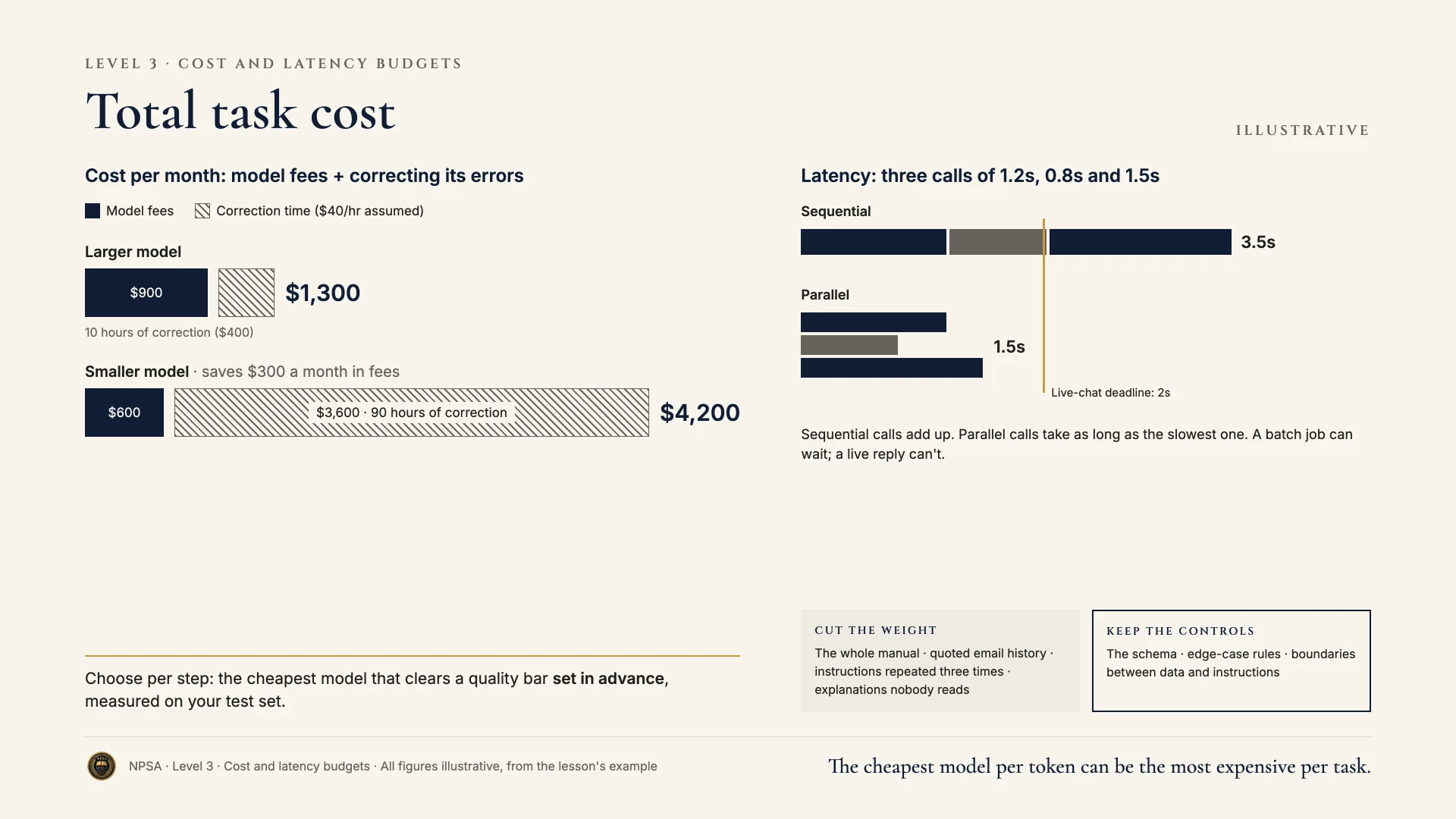
Track cost per completed outcome, not per call. Retries, timeouts, human rework, and incident handling all belong to the outcome they served. A workflow that looks cheap per call can be expensive per resolved case.
Set thresholds with losses and capacity
An escalation threshold trades missed cases against review load. Estimate the cost of each miss and each false escalation, and the review capacity you actually have. Choose the threshold with the lowest expected cost that fits capacity. Then add hard rules for harms that money doesn't capture: some cases always escalate regardless of score.
Threat model the whole path
A retrieval-augmented agent reads documents, calls tools, and writes outputs. An attacker who controls a document can try to steer tool calls (injection) or get the agent to send data somewhere it shouldn't (exfiltration). Map assets, attacker-controlled inputs, trust boundaries, and tool permissions. Red-team multi-step paths with realistic goals, in an isolated environment with synthetic data, not just a list of override phrases.
Harden the boundaries
- Send models and tools only the fields each step needs.
- Measure input length at ingestion. If content is cut, flag it and tell the user what wasn't processed. Never let truncation pass silently.
- Parse and validate every tool response before the next stage uses it. Quarantine malformed results instead of letting the model "repair" them.
- If an optional step fails, such as enrichment from a secondary system, complete the core task and mark what's missing instead of failing everything or guessing.
Plan for vendor change
Providers update models and change behavior. Pin versions where possible, monitor release notes, run your regression suite on any change, and keep a tested fallback with documented limits.
When something breaks, look beyond the prompt
An unchanged prompt can behave differently because of runtime settings: maximum input or output tokens, temperature, retrieval index version, tool timeouts, or a new default model. Check the full configuration.
Close the loop
Each incident gets an owner, a root cause, a new regression test, and a control change. A runbook names who's on call, how to detect the failure, how to recover, and when to escalate.
Worked example
Andre Kowalski runs operations AI for a property management company with 18,000 residential units. An agent triages maintenance requests, retrieves building manuals, creates work orders, and enriches requests with vendor availability. In March, a tenant's long message ended with "and there's a gas smell near the stove." The agent filed it as routine.
Weak approach. Add "ALWAYS treat gas as an emergency" to the prompt and close the incident.
Better approach. Andre runs a structured review.
Before:
Incident: gas request misfiled. Fix: added gas warning to prompt.
Closed.
After:
Incident review: MR-0311 (owner: A. Kowalski)
Root cause: prompt unchanged, but platform update lowered max input
from 8,000 to 2,000 tokens. Tenant message truncated silently;
"gas smell" was cut.
Controls added:
1. Ingestion length check; truncated messages flagged to dispatcher
   with "content not processed" note.
2. Keyword pre-check (gas, smoke, CO, sparking, flooding) before
   the model; matches always escalate.
3. Vendor-availability enrichment failure now completes triage
   with "vendor data unavailable" instead of timing out.
4. Work-order tool responses schema-validated before dispatch.
5. Tenant phone and unit access codes removed from model input.
Threshold (30-day costs): missed emergency about $40,000; false
escalation about $8 of on-call time; capacity 120/day.
  T1: 80/day, 1.0 misses/mo = $19,200 + $40,000 = $59,200
  T2: 115/day, 0.4 misses/mo = $27,600 + $16,000 = $43,600
  T3: 140/day, exceeds capacity
  Selected T2, plus keyword rule above.
Tests: 12 truncation and emergency cases added to regression suite.
Runbook updated: detection, rollback, on-call contacts.
Red team: next quarter, test attacker-edited manual pages steering
work-order tool.
Why this is stronger. The review found that the runtime configuration changed, not the prompt, so a prompt warning wouldn't have helped. Truncation is now detected and disclosed. The threshold balances expected losses within real capacity, and the gas rule covers harm that expected cost understates. The failure became tests, controls, and a runbook entry with an owner.
Try it
Setup. Choose an AI workflow you run or depend on. Write down two failure types: a missed case and a false alarm.
Task. Estimate a rough cost for each and your daily review capacity. Calculate expected monthly cost at two different escalation levels. Then list every runtime setting besides the prompt that could change behavior.
What a good result looks like. Your calculation shows its formula and stays within capacity. You've named at least one case that should always escalate regardless of cost. Your settings list includes at least four items beyond the prompt text.
Recap
- Attribute retries, rework, and incidents to outcomes.
- Set thresholds on losses and capacity, with hard rules for severe harms.
- Threat model and red-team full attack paths, not just phrases.
- Strip fields, detect truncation, validate tool output, and degrade gracefully.
- Check runtime configuration in incidents, and turn every failure into an owned test and control.