Loading lesson…
Instruction, context, examples, format
20 min read
Most weak prompts are missing a part, not a magic phrase. This module gives you a simple structure for everyday requests: say the task, give the context it needs, state the requirements, and describe the output you want. You'll use it any time you ask an AI tool to draft, summarize, or reformat something at work.
What you will be able to do
- Write a prompt using a Task-context-requirements-output structure, with an Explicit task and deliverable.
- Supply relevant source input and Select task-relevant context, keeping the task visibly apart from the background (Separate task and background).
- Set Measurable constraints and output format and Audience and style requirements, including Supply measurement units for any number.
- Use examples to specify a pattern and Recognize negative constraints in a request.
- Avoid conflicting requirements and Keep requirements simple and inspectable.
- Distinguish one task from multiple tasks and Decompose tasks for inspectability when a request is too big to check in one pass.
The idea
A useful prompt has four working parts.
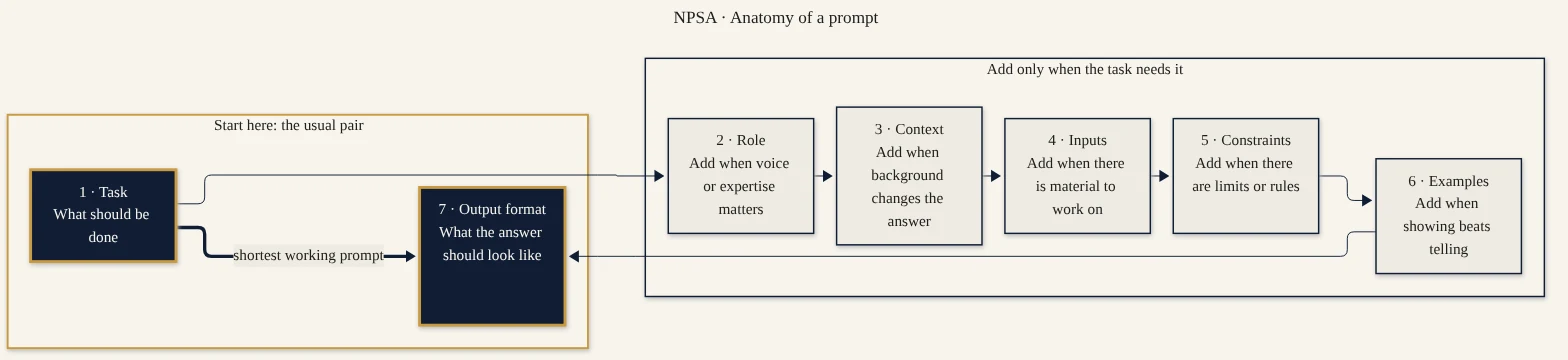
- Task. One sentence that says what to produce. "Draft a reminder email" names a deliverable. "Help with this invoice" does not.
- Context. Only what changes the answer: the source text, who it's for, the situation. Paste the actual document. Naming a file the tool can't open gives it nothing to work from.
- Requirements. Limits you can check: word count, tone, what must be included, what must not be. "Short" can't be checked. "Under 120 words" can.
- Output. The shape you want back: a numbered list, three bullet points, a subject line plus body.
Keep the task and the background in separate places so the reader, human or model, can tell which sentence is the instruction. Leave out context that wouldn't change the answer. A paragraph about your team's history makes the prompt longer without making the result better.
Watch for requirements that fight each other. "Keep it under 50 words and explain every line item" can't both be true. Pick one, or give a priority.
Prefer a few plain requirements over many clever ones. You should be able to read the output and tick each requirement off. If you can't check it, you can't tell whether you got it.
Worked example
Priya Shah works in accounts receivable at a printing company. A customer, Halvorsen Dental, is 21 days late on invoice 4471 for $1,348.50. Priya wants a reminder email.
Before:
Can you write a nice but firm email to Halvorsen about their late
invoice and also make me a list of all our overdue accounts and
suggest a better payment policy? Make it short but thorough. Our
company has been around since 1994 and we pride ourselves on service.
That prompt hides three tasks in one sentence, has no invoice details, contradicts itself ("short but thorough"), and spends space on company history that won't change the email.
After:
Task: Draft one payment reminder email to a customer.

Context:
- Customer: Halvorsen Dental, contact Ana Brooks (office manager)
- Invoice 4471, amount $1,348.50 (USD), due October 3, now 21 days late
- Payment options: card by phone at 555-0142, or bank transfer
  using the details on the invoice

Requirements:
- Courteous, direct tone for a long-standing customer
- 90 to 120 words in the body
- Include invoice number, amount, and days late
- Do not mention late fees or collections
- Do not invent a new due date

Output: A subject line, then the email body.
Why this is stronger. It asks for one deliverable. The invoice facts come from Priya, so the model doesn't have to guess them. Each requirement can be checked by reading the draft: count the words, look for the invoice number, confirm no late fee appears. The "do not" lines are negative constraints, and they're stated plainly so they're easy to spot. The overdue list and the policy idea are separate tasks for separate prompts.
Examples and units
When the format matters, show it. If Priya wants subject lines in a fixed style, one example does more than an adjective:
Use this pattern: "Reminder: Invoice 4471, $1,348.50, 21 days past due"
Apply it to each invoice I list. Use the real values, not the example's.
An example teaches a pattern. Say which parts change, or the model may copy the example's numbers into every line.
Numbers need units. "Allow 30 for the call" could be minutes or seconds. "Budget 2,000" could be dollars, euros, or sheets of paper. Write "30 minutes" and "$2,000 USD."
When one prompt is too many tasks
If a request has steps that depend on each other, split it. Priya's overdue-accounts list should come first, she checks it against the billing system, and only then does she ask for a summary. Each step produces something small enough to inspect before the next step relies on it.
Try it
Setup. Find a real request you've typed or might type, for example asking for a meeting summary, a shift-swap notice, or a product description.
Task. Rewrite it in a text editor under four labels: Task, Context, Requirements, Output. Add at least one number with a unit and one "do not" line. If your original asked for more than one thing, cut it to one and save the rest for a second prompt.
What a good result looks like. Someone else could read your requirements and check each one against the output without asking you a question. No two requirements contradict each other. The Task line names a single deliverable.
Recap
- Task, context, requirements, output. Check each part is present.
- Give the tool the actual source, and only the context that changes the answer.
- Write requirements you can verify, with units on every number.
- Use an example to show a pattern, and say which parts vary.
- One prompt, one task. Split work that has dependent steps.