Loading lesson…
Task framing
20 min read
Task framing is the work you do before the model writes anything: deciding what the deliverable is, who it's for, and what the model needs to know to produce it. At work, most disappointing outputs trace back to a frame that was too thin or too clever. This module shows you how to frame a task so the first draft is close and the follow-ups stay on target.
What you will be able to do
- Define deliverable with relevant business context: name the artifact, its purpose, and the facts that shape it.
- Use a role only where it helps, and Pair role framing with task criteria, knowing that Role framing does not grant authority.
- Adapt presentation to audience and Define tone through audience and samples instead of adjectives alone.
- Change presentation without changing facts when you produce versions of the same message.
- Identify referent in follow-up instructions and Decompose complex tasks into parts you can check.
The idea
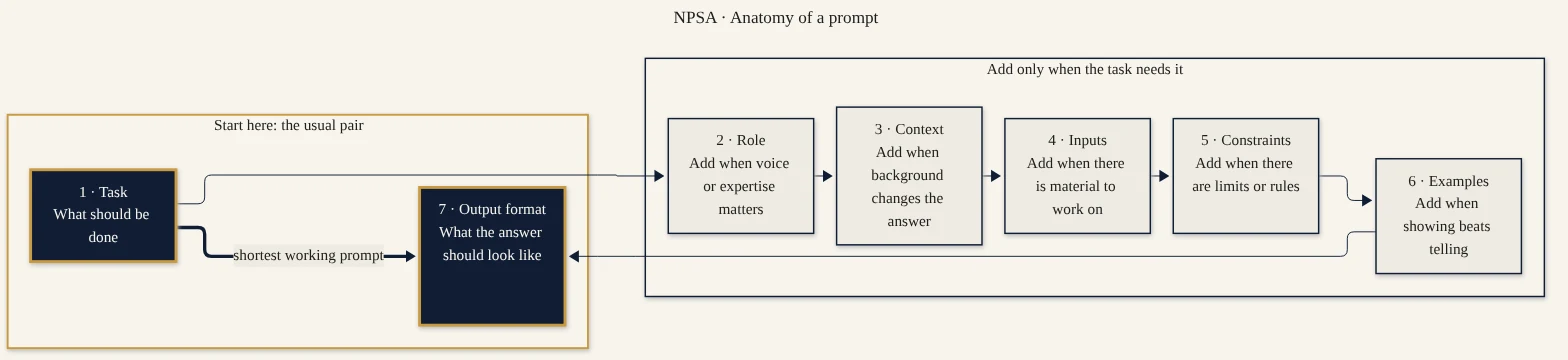
Start with the deliverable. "Help with the benefits change" is a topic. "A 150-word intranet post announcing the new dental carrier, effective January 1" is a deliverable. Add the business context that changes the answer: the date, what is actually changing, what isn't, who is affected, and where readers go with questions. Leave out history that wouldn't change a sentence.
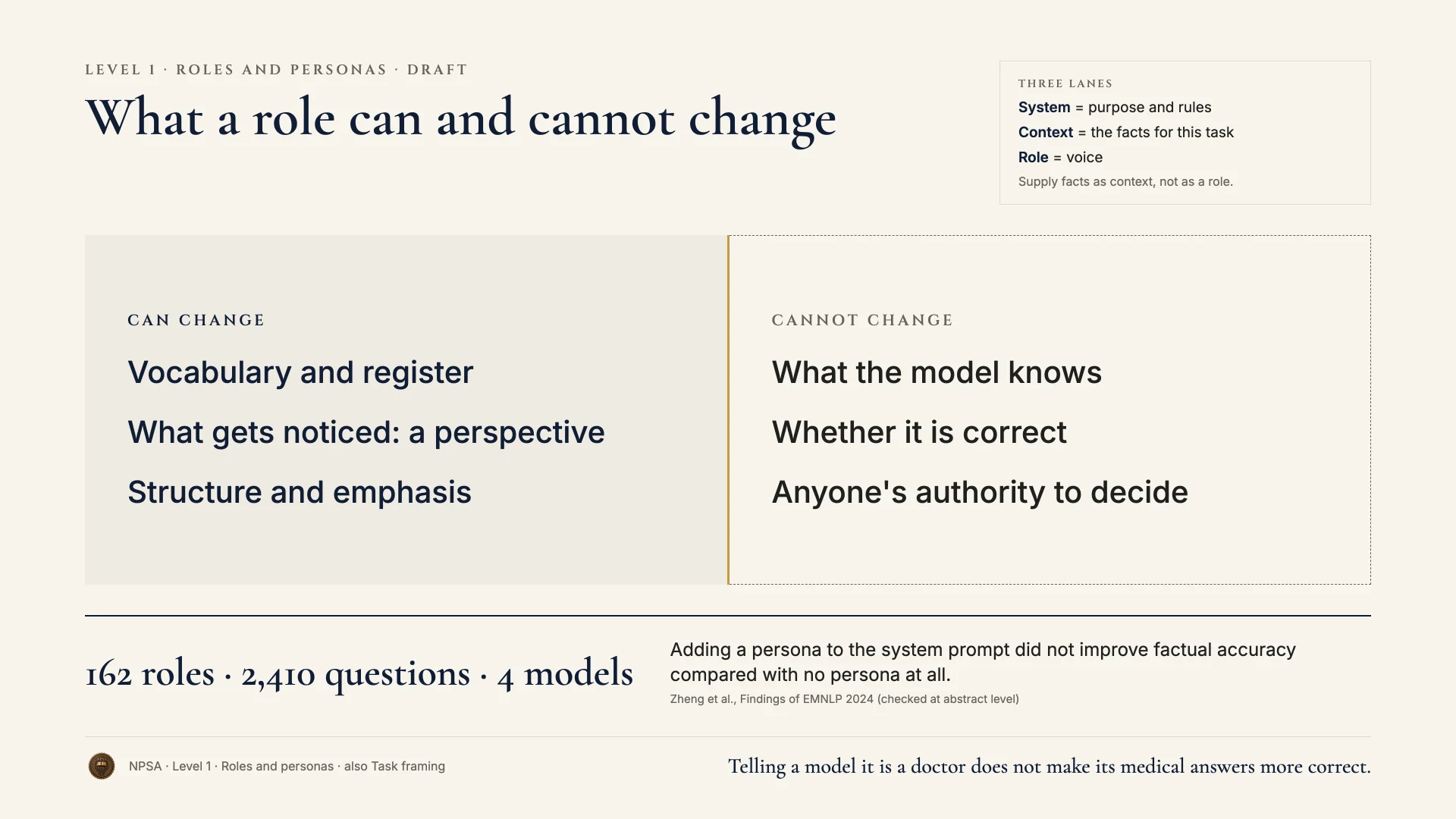
Roles set a register, not a license. "You are an experienced HR communications writer" can nudge vocabulary and structure. It doesn't make the output correct, and it doesn't give the model, or you, the standing to make decisions. "Act as our benefits attorney" won't produce legal advice anyone can rely on, and it can't grant an exception to a plan rule. If a role helps, pair it with criteria the output must meet: length, required facts, what to leave out. The criteria do the real work.
Audience drives presentation. The same fact lands differently for a finance analyst, a warehouse supervisor, and a new hire. Say who the reader is, what they already know, and what they need to do next. For tone, a short sample of writing you like beats "friendly but professional," which means something different to everyone.
Versions must share facts. When you ask for a manager version and an employee version, the dates, amounts, and deadlines must match exactly. Tell the model the facts are fixed and only the presentation changes.
Follow-ups need a clear target. In a long chat, "make it shorter" could mean the email, the summary, or the FAQ. Name the item: "Shorten the employee version only. Leave the manager version as is."
Big tasks get split. If the request has parts that depend on each other, run them in order and check each one before the next relies on it.
Worked example
Renata Okafor, an HR generalist at a 400-person logistics company, needs to announce that the dental plan carrier is changing on January 1. Premiums stay the same. New ID cards arrive by December 15. Open enrollment runs November 18–29. Questions go to benefits@example.com.
Before:
You are a top HR attorney. Write something about the dental change
for everyone. Make it friendly and professional. Then do a manager
version. Then make it shorter.
The attorney role adds nothing the task needs and implies a legal review that didn't happen. "Something" isn't a deliverable. "Everyone" and "friendly and professional" don't define an audience or a tone. "Make it shorter" has no clear referent.
After:
Task: Write the employee version of an intranet post announcing a
dental carrier change. I'll review it before asking for the
manager version.

Fixed facts (must appear unchanged in every version):
- New dental carrier effective January 1
- Premiums do not change
- New ID cards arrive by December 15
- Open enrollment: November 18-29
- Questions: benefits@example.com

Employee version:
- Readers: hourly and salaried staff, many reading on a phone
  between shifts
- 120 to 150 words, plain language, no insurance jargon
- Tone sample: "Your paycheck won't change. Here's what will."
- End with the one action they need to take, if any

Do not: give coverage advice, compare carriers, or add facts not
listed above. Do not write the manager version yet.
Why this is stronger. The deliverable, audience, and length are explicit. The fixed-facts block lets every later version be checked line by line. The tone sample shows the voice instead of describing it. The two versions are split into steps, so Renata checks the first before the second builds on it. When she later says "shorten the manager version to 80 words," there's only one thing that can mean.
Try it
Setup. Pick an announcement from your own work: a schedule change, a new tool, a policy update. Write down the facts in a plain list.
Task. Write a prompt that asks for one version for frontline staff. Include the deliverable, the audience, a length range, one sentence of tone sample, and a "Do not" line. Run it. Then ask for a second version for managers, naming that version explicitly in your follow-up.
What a good result looks like. Put the two outputs side by side. Every fact from your list appears in both, with identical dates and numbers. The presentation differs in length and emphasis. Your follow-up named which version to write, and the model didn't edit the first one.
Watch for this
A long frame can bury the task. If your context runs past a screen, put the task line first and the fixed facts in their own labeled block.
Recap
- Name the deliverable and the business facts that shape it.
- A role sets register. Criteria set quality. Neither grants authority.
- Define tone with an audience and a short sample.
- Versions share facts. Only presentation changes.
- Name the target of every follow-up, and split dependent work into steps.