Loading lesson…
Privacy, safety, and human review
20 min read
As AI moves from drafting emails to helping with decisions about people, the stakes change. A clumsy sentence costs a few minutes. A biased shortlist or a leaked record costs someone a job, a benefit, or their privacy. This module covers how to share less personal data, keep outputs inside safe boundaries, watch for bias in both the model and your own instructions, and keep consequential decisions with a person who is accountable for them.
What you will be able to do
- Minimize unnecessary personal data before prompting, including details that identify someone indirectly.
- Respect safety boundaries and user impact by stating what the output must not do and who could be affected.
- Spot Bias in training data and instructions, including criteria you wrote yourself.
- Design a workflow with Human review for consequential decisions, where the reviewer has evidence and real power to change the outcome.
The idea
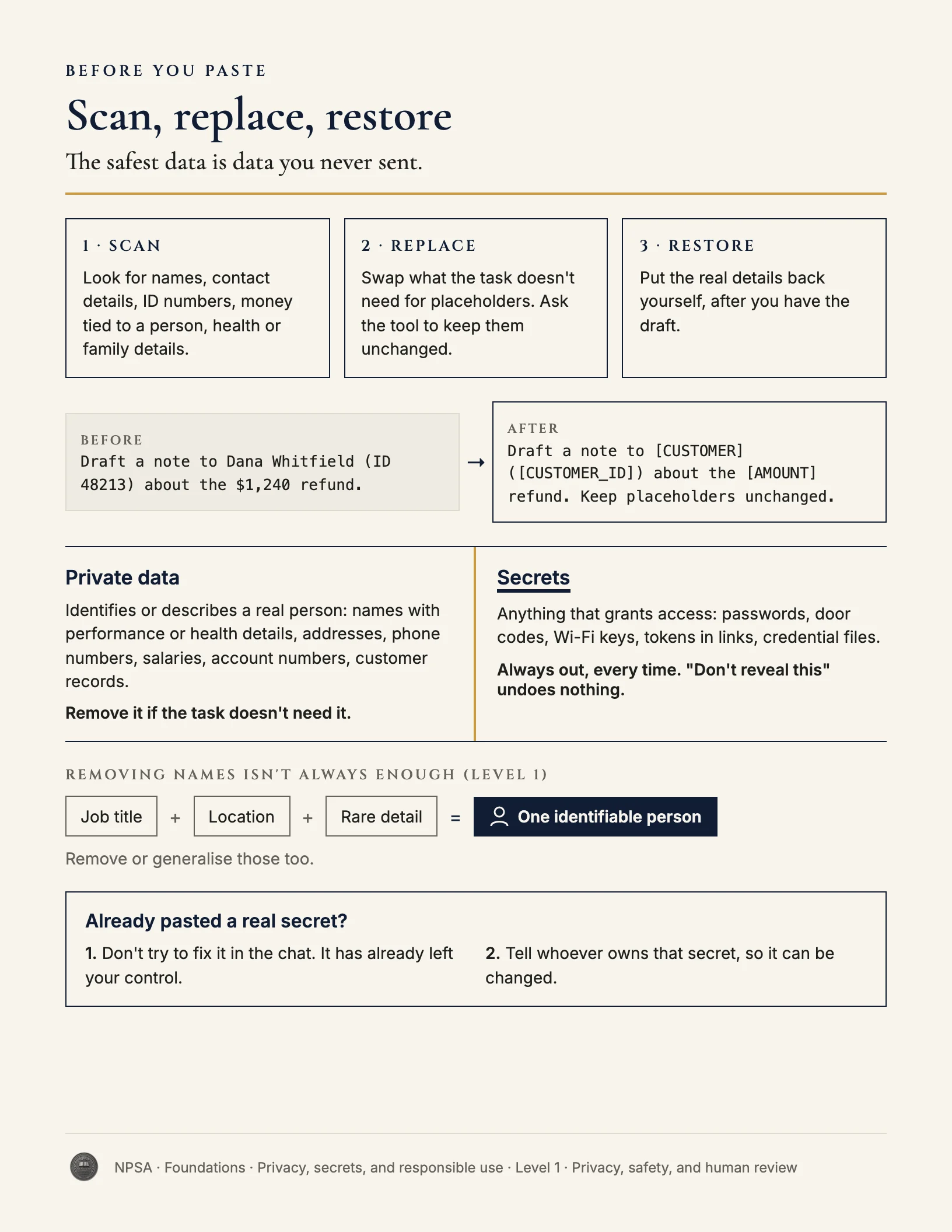
Share the minimum. Decide what the task actually needs before you paste anything. Theme analysis of feedback doesn't need names or account numbers. Removing names isn't always enough, though. A job title plus a location plus a rare detail can point to one person. Remove or generalize those too. Asking the model to "keep this confidential" doesn't undo what you already sent.
Think about who's affected. Before you send an output to anyone, ask who reads it and what they'll do with it. A reply to a customer in distress shouldn't give medical, legal, or financial advice. It should route them to the right person. State these limits in the prompt, and add a rule for when to stop and escalate.
Bias comes from two places. Models learn from large amounts of human text, which carries patterns about age, gender, accent, background, and more. Those patterns can show up in rankings and descriptions. Your instructions can add bias too. Criteria like "seems like a good fit," "professional appearance," or "articulate" invite judgments that track background rather than ability. Use job-related, documented criteria. Don't ask the model to infer traits it can't see.
Human review has to be real. "A manager will check it" isn't a safeguard if the manager only sees a ranked list and signs off on the top three. Real review means the person sees the evidence behind each item, sees what's missing, can override the output, and is accountable for the final call. The model supports the decision. It doesn't make it.
Worked example
Omar Haddad coordinates a hardship assistance fund at a 2,000-employee retailer. Employees apply for one-time grants of up to $1,500. Applications include written explanations, and some mention medical issues, family situations, or immigration paperwork. The fund has written eligibility criteria: employed 6+ months, documented unexpected expense, and no grant in the past 12 months. Omar has 85 applications and wants help triaging.
Before:
Here are all 85 applications. Rank them from most to least
deserving and pick the top 20 to fund. Prioritize people who seem
genuinely in need and well spoken.
The full applications expose sensitive personal details the task doesn't need. "Deserving," "genuinely in need," and "well spoken" are subjective and invite bias toward writing style and background. And the model is being asked to make the funding decision.
After:
I will paste applications with names, employee IDs, and any medical
or family details replaced by [REDACTED]. Each has an application
number.

For each application, report only:
- Tenure of 6+ months: yes / no / not shown
- Documented unexpected expense: yes / no / not shown, with the
  document type named
- Grant in the past 12 months: yes / no / not shown
- Anything unclear, quoted briefly

Do not rank, score, or recommend applicants. Do not comment on
writing quality, tone, or personal circumstances. Do not infer
anything not stated.

If an application mentions immediate risk to someone's safety,
write "URGENT - route to Omar" and nothing else for that entry.
Why this is stronger. The model sees only what eligibility checks need. It reports against documented criteria instead of impressions, so writing style can't tilt the result. It doesn't decide anything. Omar and the fund committee review every summary against the original application, override errors, and make the funding decisions themselves. The urgent rule makes sure a safety concern reaches a person right away instead of sitting in a list.
Try it
Setup. Pick a task where AI could help with a decision about people: screening event volunteers, sorting customer complaints for escalation, reviewing training feedback.
Task. In a text editor, write two lists. First, the personal data the task actually needs and the data it doesn't. Second, your decision criteria. Mark any criterion that relies on impression rather than a documented fact, and rewrite it. Then write a prompt that asks for evidence against those criteria only, with no ranking, one escalation rule, and the name of the person who makes the final call.
What a good result looks like. Your "doesn't need" list is longer than your "needs" list. Every criterion can be checked against a document or record. The prompt asks the model for evidence, not a verdict, and names the person who makes the final call.
Watch for this
Speed pressure erodes review. If a reviewer is signing off on 85 items in 10 minutes, the review is in name only. Plan the time it takes.
Recap
- Share the minimum, and watch for details that identify someone indirectly.
- State what the output must not do, and when to escalate.
- Bias can come from the model and from your own criteria.
- Use documented, job-related criteria, not impressions.
- Keep consequential decisions with an accountable person who sees the evidence.