Loading lesson…
Prompt checklists: CRAFT and RICCE
25 min read
You'll meet prompt acronyms everywhere: CRAFT, RICCE, and a dozen others. Each one is a checklist that names the parts of a prompt so you don't forget one. This module shows you what two common checklists cover, what they leave out, and how to use one to review a prompt without mistaking a filled-in form for a good prompt.
What you will be able to do
- Name the parts of the CRAFT and RICCE checklists and match each part to something you already know from task framing.
- Spot what each checklist leaves out.
- Use a checklist to review a draft prompt and find the missing part.
- Explain why these checklists are memory aids and not proven methods.
The idea
CRAFT stands for Context, Role, Action, Format, Tone. You'll also see versions where the last letter is Target audience, or the A is Audience. There is no official version and no single author.
RICCE stands for Role, Input, Context, Constraints, Examples. It is taught in the University of South Carolina's Garnet AI Fluency 101 course, among other places. Some versions swap Input for Instructions.
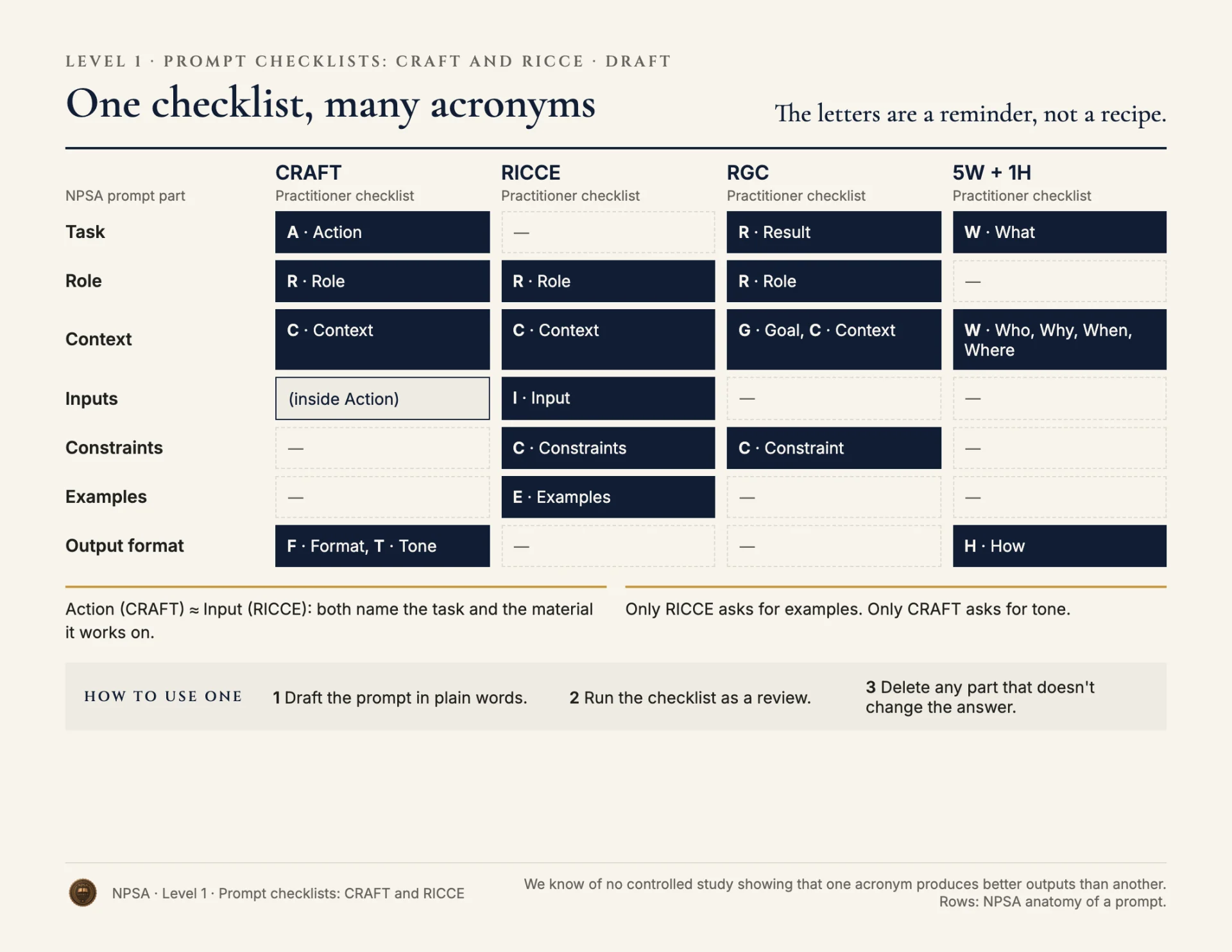
Put side by side, the two lists mostly rename parts you already use:
- Context (both): the background the model can't know unless you say it. Who this is for, what happened, what matters.
- Action (CRAFT) and Input (RICCE): the task itself, plus any material the model should work on.
- Format (CRAFT): the shape of the answer. Length, sections, a list, a set of named fields.
- Tone (CRAFT): how it should sound to the reader.
- Constraints (RICCE): the limits. What to leave out, what must be true, what to do when information is missing.
- Examples (RICCE): one or more samples of what good looks like.
- Role (both): a perspective for the model to take.
Each list has a gap. CRAFT has no slot for constraints or examples. RICCE has no slot for output format or tone. If you rely on one acronym, you inherit its gap. That is the main reason to know more than one, and the reason not to treat any of them as complete.
What the evidence says. These checklists come from practitioners and trainers. We know of no controlled study showing that one acronym produces better outputs than another, or better outputs than a plain prompt that covers the same parts. What a checklist does is make an omission visible. That is useful, and it is all a checklist does.
Use it to review, not to fill in. Write the prompt in plain sentences first. Then read it against the checklist and ask of each part: is it here, and does this task need it? A part the task doesn't need stays empty. A one-line question rarely needs a role, a tone, and three examples. Padding every slot makes the prompt longer and gives the model more to misread.
Role is the part most often overused. "You are a world-class analyst" adds no facts and no criteria. The next module, Roles and personas, covers when a role earns its place and what to write instead.
Worked example
Priya Raman coordinates volunteers at a regional food bank. A refrigerated truck broke down, so Saturday's pickup at one site is canceled. She needs a message for the 40 volunteers signed up for that shift.
Before:
Context: Food bank.
Role: You are an expert communicator.
Action: Write a message about Saturday.
Format: Message.
Tone: Good.
Every slot is filled and the prompt is still empty. The model doesn't know what happened on Saturday, who is reading, or what they should do next. The role adds nothing. Filling in a checklist did not produce a specification.
After:
Write a text message to 40 volunteers signed up for Saturday's
9:00 a.m. pickup shift at the Elm Street site.

What happened: our refrigerated truck broke down, so the Elm
Street pickup is canceled this Saturday only. The warehouse
sorting shift (10:00 a.m. to 1:00 p.m., 220 Mill Road) still
needs 12 people.

The message must:
- Say the Elm Street shift is canceled, in the first sentence.
- Invite them to the warehouse shift and say how to sign up:
  reply YES to this message.
- Say next Saturday's Elm Street shift is on as planned.

Limits: under 60 words. Don't apologize more than once. Don't
give a reason beyond "truck repair." If a detail isn't given
here, leave it out instead of guessing.

Tone: warm and brief, like a note from a coordinator they know.
Priya then checks the draft against both lists. Context, action, format (a text under 60 words), tone, and constraints are present. She left out role and examples on purpose: the task doesn't need a perspective, and the limits describe the result well enough.
Why this is stronger. The content came first and the checklist came second. Each part that is present carries real information. The two parts left out were left out by decision, not by accident. Reading against RICCE as well as CRAFT is what prompted the limits, which CRAFT alone would not have asked for.
Try it
Setup. Find a prompt you wrote recently that gave a mediocre result. If you don't have one, write a quick prompt asking for a reminder message about an upcoming deadline.
Task. Read the prompt against CRAFT, then against RICCE. For each part, write one of three notes: present, missing and needed, or not needed. Add only the parts you marked missing and needed. Run both versions.
What a good result looks like. You find at least one part that was missing and needed, most often constraints or format. You mark at least one part not needed and can say why. The second output needs less editing than the first.
Watch for this
A filled-in checklist can feel finished. Judge the prompt by what the output does for the reader, the way you would with any draft, and not by how many slots have text in them.
Recap
- CRAFT and RICCE are checklists that name the parts of a prompt.
- CRAFT has no slot for constraints or examples. RICCE has no slot for format or tone.
- They are practitioner memory aids. They are not backed by controlled studies.
- Write the prompt first, then review it against a checklist.
- Leave a part out when the task doesn't need it, especially role.
Sources
- CRAFT: practitioner checklist with several published variants and no single origin. Example: University of Maryland, Baltimore, "Prompting with CRAFT" (training guide), where Role sits inside Context.
- RICCE: practitioner checklist. Example: University of South Carolina, Division of Information Technology, AI prompt library for the Garnet AI Fluency 101 course.