Loading lesson…
Roles and personas: what they change
25 min read
"You are an expert..." is the most common opening line in prompting advice. A role or persona tells the model who to answer as. It can change how an answer sounds and what it pays attention to. It does not give the model knowledge it lacks, and research shows that the wrong details in a persona can make answers worse. This module covers what a role really changes, what the studies found, and what to write instead when a role isn't doing any work.
What you will be able to do
- Say what a role or persona changes in an output and what it doesn't.
- Describe what published studies found about personas and accuracy.
- Tell a task-relevant role from decorative detail, and remove the detail.
- Replace a role with a description of the reader and the criteria when that does the job better.
The idea
What a role is. A role is an instruction to answer from a position: "as a payroll specialist," "as a first-time buyer would read this." A persona adds a character on top: a name, a background, a personality. Both are instructions like any other part of the prompt.
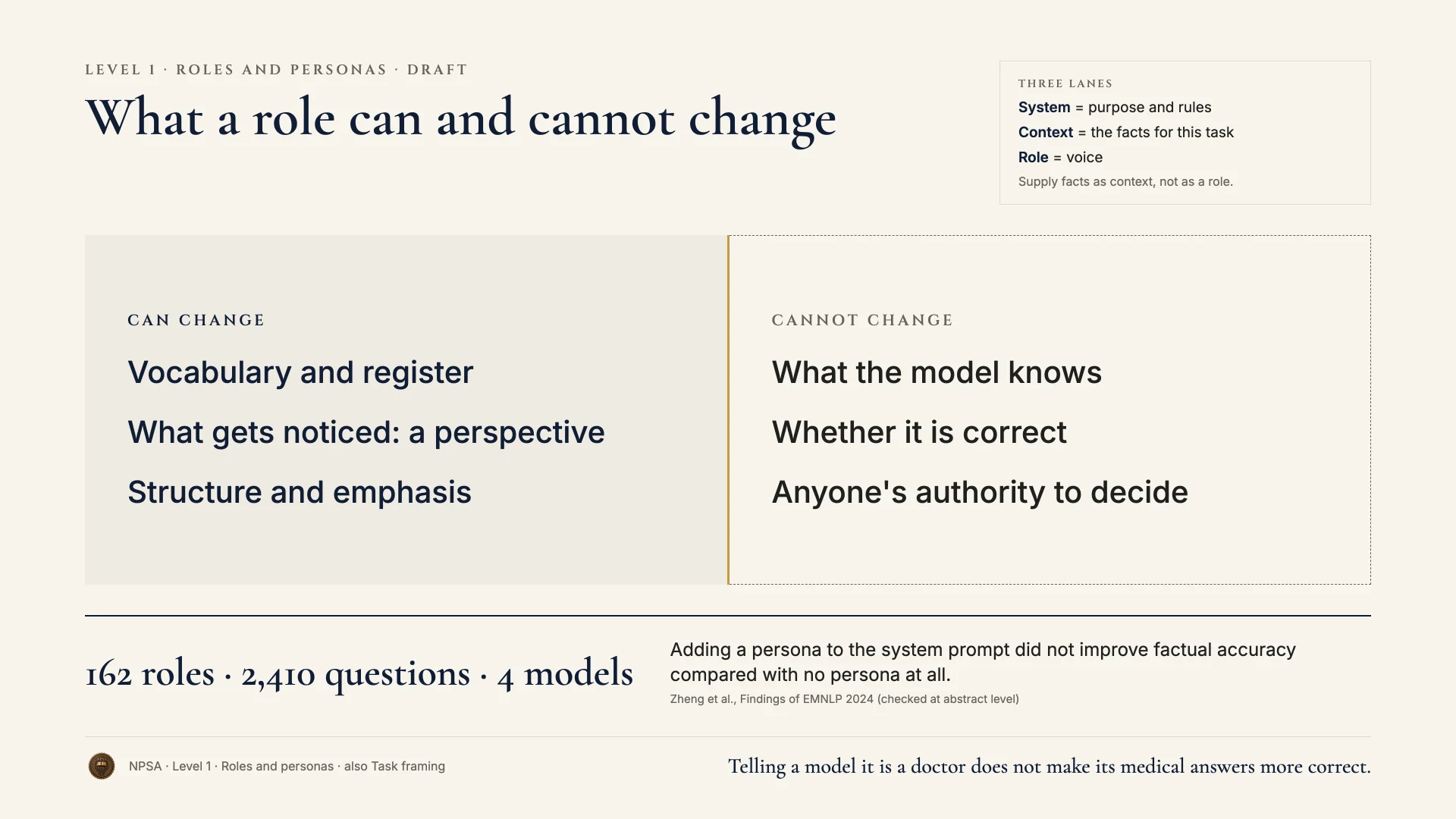
What a role can change. Voice, vocabulary, level of detail, and what gets noticed. "Review this lease as a tenant's advocate would" directs attention to terms that disadvantage the tenant. That is a real effect, and it's why a role is sometimes worth including.
What a role can't change. What the model knows. Zheng and colleagues (2024) tested 162 different roles on 2,410 factual questions across four families of models. Adding a persona to the system prompt did not improve accuracy compared with no persona at all. Telling a model it is a doctor does not make its medical answers more correct, and it never makes them qualified advice.
Extra detail can hurt. Luz de Araujo and colleagues (2025) tested nine models on 27 tasks. Expert personas that matched the task usually produced either a small gain or no significant change. But when a persona included details that had nothing to do with the task, performance fell, in some cases by almost 30 percentage points. A favorite color, a hometown, a hobby: the model treats everything in the prompt as possibly relevant, and decoration becomes noise.
So the working rules are short.
- Use a role when a perspective changes what should be noticed. If you can't say what the role changes about the output, leave it out.
- Keep it to the task. A profession or a point of view. No biography, no personality traits, no superlatives.
- Don't use a role as a stand-in for facts. If the answer depends on information, supply the information.
- Leave out personal attributes such as age, gender, or background unless the task is truly about them. They add nothing useful to most tasks and can pull stereotypes into the output.
Often the reader is what you meant. People write "you are a kindergarten teacher" when they mean "write this so a five-year-old's parent can follow it." Describing the reader and the criteria is more direct: who will read this, what they already know, what they need to do, how long it should be. That tells the model what a good answer looks like without asking it to act a part.
Role or reader: a quick test. Delete the role line and run the prompt again. If the output is no worse, the role wasn't doing anything. If it is worse, look at what changed, and see whether a plain instruction would produce the same effect more reliably.
Worked example
Martin Kowalski manages a community recreation center. The youth soccer league asked for a one-page handout for parents about keeping kids hydrated during summer practices. He has the league's heat and hydration guidance, a two-page document from its medical advisor.
Before:
You are Dr. Sarah Bennett, a world-renowned pediatric sports
nutritionist with 25 years of experience. You graduated top of
your class, you love hiking with your two golden retrievers, and
you are passionate about children's health. Write a handout
about hydration for youth soccer.
The persona adds a name, a résumé, pets, and enthusiasm. None of it tells the model who the handout is for, how long it should be, or what it should say. The invented credentials make the output sound authoritative, which is a problem: the handout's facts would come from the model's general knowledge and not from the league's own guidance.
After:
Write a one-page handout for parents of players aged 8 to 12 in
a summer soccer league.

Use only the league guidance between the <guidance> tags. Don't
add advice that isn't in it. If parents would expect something
the guidance doesn't cover, list it at the end under "Not
covered in league guidance" so I can ask the medical advisor.

Readers: busy parents, reading on a phone at the field. Many
are new to youth sports.
They need to know: what to send with their child, how much and
how often to drink, and the warning signs that mean a child
should stop playing.

Format: a short opening sentence, then three sections with
plain headings and no more than four bullet points each. Under
250 words. No medical terms without a plain explanation.

End with: "This handout summarizes league guidance. It is not
medical advice. Ask your child's doctor about their needs."

<guidance>
[league heat and hydration guidance]
</guidance>
Martin runs the delete test on his first draft, which had opened with "You are a youth sports coach." Without the line, the output is the same. He leaves it out.
Why this is stronger. Everything the persona was supposed to achieve is now stated directly: who reads it, what they need, how it should look. The facts come from the league's guidance, not from an invented expert. Nothing in the prompt is decoration that could pull the answer off course. The closing line is honest about what the handout is.
Try it
Setup. Find a prompt of yours that starts with "You are..." or "Act as...". If you don't have one, write a prompt asking for an explanation of a workplace topic, starting with an elaborate expert persona.
Task. Run it as written. Delete the role and run it again. Then replace the role with three lines: who the reader is, what they need to do, and the format. Compare the three outputs.
What a good result looks like. You can say specifically what the role changed, or that it changed nothing. The reader-and-criteria version is at least as good as the role version. You removed at least one detail that had nothing to do with the task.
Watch for this
- A persona with credentials makes output sound more trustworthy without making it more correct.
- Role wording copied from a prompt collection often carries details irrelevant to your task. Strip it down.
- In a shared prompt, a named character invites people to keep adding to the backstory. Keep roles to one line.
Recap
- A role can change voice, focus, and level of detail. It doesn't add knowledge.
- A study of 162 roles found no accuracy gain on factual questions over no persona.
- Task-relevant expert roles help a little or not at all. Irrelevant persona details can hurt a lot.
- Keep a role to one task-relevant line, or leave it out.
- Describing the reader and the criteria is often what you meant.
Sources
- Zheng, M., Pei, J., Logeswaran, L., Lee, M., and Jurgens, D. (2024). "When 'A Helpful Assistant' Is Not Really Helpful: Personas in System Prompts Do Not Improve Performances of Large Language Models." Findings of EMNLP 2024. arXiv:2311.10054.
- Luz de Araujo, P. H., Röttger, P., Hovy, D., and Roth, B. (2025). "Principled Personas: Defining and Measuring the Intended Effects of Persona Prompting on Task Performance." EMNLP 2025. arXiv:2508.19764.