Loading lesson…
Writing workflows: outline first
25 min read
Asking for a finished document in one prompt gives you a finished-looking document. It may be organized around the wrong point, miss a required section, or fill gaps with invented detail, and you find out only after reading the whole thing. This module teaches a writing workflow built around an outline: settle the brief, agree the outline, attach the facts, and only then draft. The outline is the cheapest place to catch a problem.
What you will be able to do
- Run a writing task as a short workflow: brief, outline, facts, draft, revise.
- Review an outline for structure and coverage before any prose exists.
- Attach source facts to outline points so the draft has something to stand on.
- Say what published research found about outline-guided generation.
The idea
What the research did. Lee and colleagues (2025) built a framework called Writing Path, modeled on how people write. It has five steps: prepare the basic details of the piece, generate an initial outline, gather information, add that information to produce a fuller outline, and write the text from it. They tested it with three models, and both human reviewers and model-based scoring rated the outline-guided text higher in quality than text written without that process.
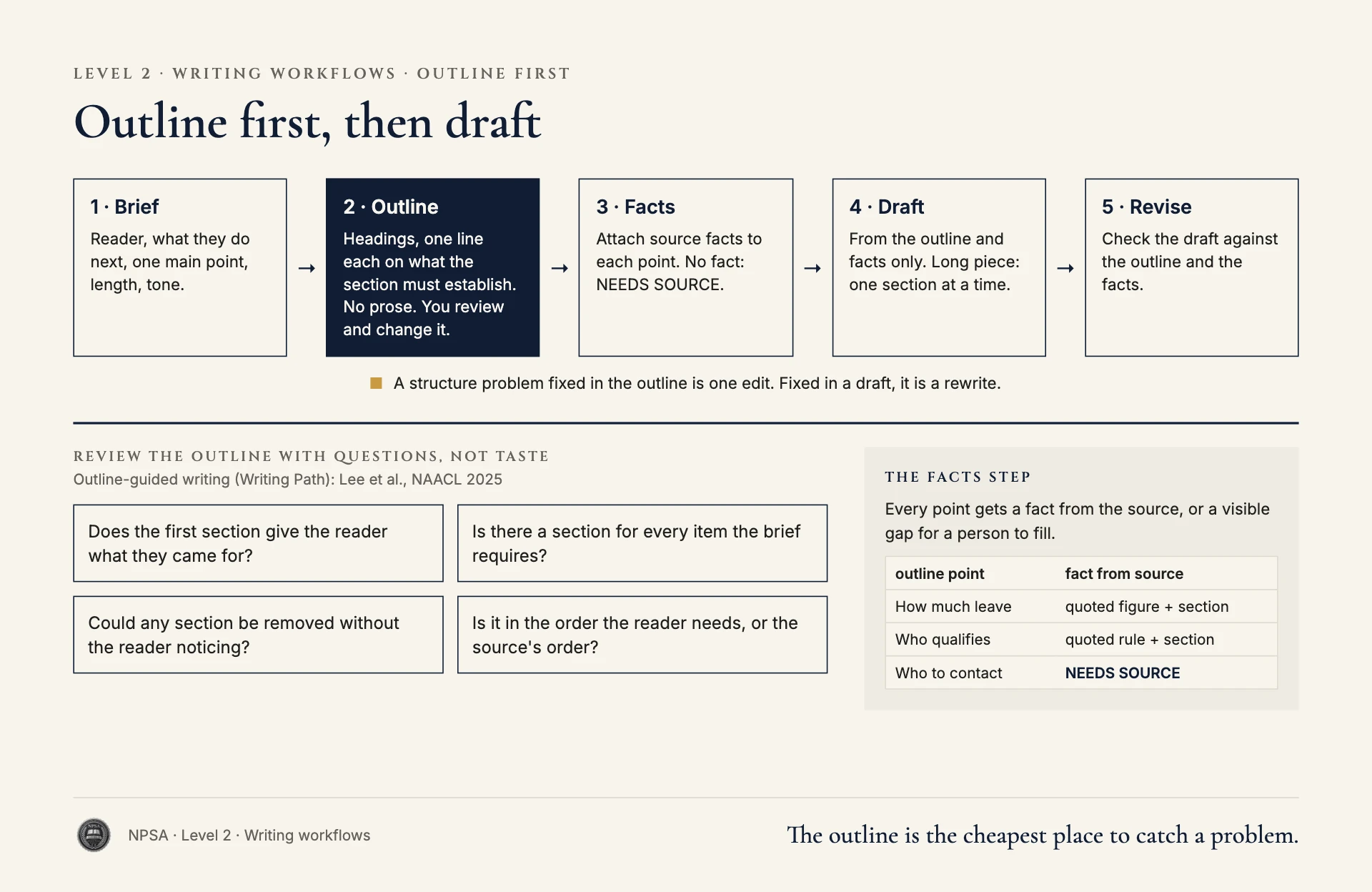
Why an outline helps. An outline is short enough to read in a minute and specific enough to disagree with. You can see that the main point is buried in section four, that the reader's first question isn't answered, or that two sections overlap. Fixing that in an outline is one edit. Fixing it in a draft is a rewrite. The outline also becomes the contract for the draft: each section has a job, and you can check whether it did it.
The workflow.
- Brief. State the reader, what they need to do after reading, the one main point, the length, and the tone. If you can't state the main point in a sentence, you aren't ready to outline.
- Outline. Ask for headings with one line under each saying what that section must establish. No prose. Review it yourself and change it.
- Facts. For each outline point, attach the facts it relies on, from your source. Mark any point with no fact behind it as NEEDS SOURCE. This is the step that keeps invented detail out.
- Draft. Write from the outline and the attached facts only. For a long piece, draft one section at a time, giving each prompt the full outline so the section knows its place.
- Revise. Check the draft against the outline and the facts, using the refine loop from the previous module if the piece warrants it.
Review the outline with questions, not taste.
- Does the first section give the reader what they came for?
- Is there a section for every item the brief requires?
- Could any section be removed without the reader noticing?
- Is the order the order the reader needs, or the order the source happens to be in?
When to skip it. A three-sentence reply doesn't need an outline. Use this for anything long enough to have sections, or anything where leaving something out has a consequence.
Worked example
Hannah Okonkwo is an HR generalist at a manufacturer with 1,400 employees. The parental leave policy changes on July 1, and she needs an intranet article explaining it. She has the nine-page policy document.
Before:
Write an engaging intranet article about our new parental leave
policy. Make it clear and friendly. Policy attached.
The model picks its own structure, usually following the policy document's order: purpose, definitions, eligibility. An employee wants to know how many weeks they get and what to do. "Engaging" invites filler. Hannah will have to read 700 words to find out whether the eligibility rule made it in.
After, prompt 1 (outline):
I'm writing an intranet article for all employees about a policy
change. Give me an outline only: no article text.

Reader: an employee who is or may soon be a new parent, and
their manager.
After reading, they should know: how much leave they get,
whether they qualify, and how to request it.
Main point: from July 1, paid parental leave is 12 weeks for all
eligible employees, up from 6.
Length of final article: 450 words.

Return 4 to 6 headings in the order the reader needs them. Under
each, one line stating what the section must tell the reader.
Put the main point in the first section.
Hannah reviews the outline. It has no section on what happens to leave already in progress on July 1, which the policy covers and employees will ask about. She adds it. She moves "How to request leave" ahead of "Background."
After, prompt 2 (facts):
Here is the approved outline and the policy document. Under each
outline point, list the facts from the policy that the section
will need, each with its section number. Quote figures and dates
exactly. If the policy has no fact for a point, write NEEDS
SOURCE. Do not write article text.
One point comes back NEEDS SOURCE: the outline promised a contact for questions, and the policy doesn't name one. Hannah supplies the HR service desk address. Prompt 3 then drafts the article from the outline and the fact list only, at 450 words.
Why this is stronger. The structure was decided by the reader's questions and corrected before any prose was written. A missing section was caught in a ten-line outline instead of a finished article. Every figure in the draft traces to a policy section. The one gap in the source showed up as NEEDS SOURCE and was filled by a person, not by the model.
Try it
Setup. Pick something you need to write that has at least three sections: a how-to, an announcement, a short report. Have the source material ready.
Task. Write a brief with the reader, what they should be able to do, the main point, and the length. Ask for an outline only. Review it with the four questions and change at least one thing. Ask for facts under each point with NEEDS SOURCE allowed. Then draft.
What a good result looks like. You changed the outline before drafting and can say why. At least one point exposed a gap in your source. The draft follows the outline section by section, and you can check any figure against the fact list.
Watch for this
- An outline that mirrors the source document's order is organized for the author. Reorder it for the reader.
- If you skip the facts step, the draft fills thin sections with plausible detail.
- Approving an outline you didn't really read moves the problem downstream. Read it.
Recap
- Settle the brief first: reader, action, main point, length.
- Get an outline with one line per section, and review it before drafting.
- Attach source facts to each point, and mark gaps as NEEDS SOURCE.
- Draft from the outline and facts only.
- Research with three models found outline-guided writing was rated higher in quality.
Sources
- Lee, Y., Ka, S., Son, B., Kang, P., and Kang, J. (2025). "Navigating the Path of Writing: Outline-guided Text Generation with Large Language Models." NAACL 2025, Industry Track. arXiv:2404.13919.