Loading lesson…
Chain patterns: refine loops and sub-tasks
25 min read
The Decomposition module showed you how to split a task into stages with outputs you can inspect. This module adds two patterns you'll use often, the refine loop and the sub-task library, and the published evidence for running steps as separate prompts instead of asking for everything at once. It also covers the question that keeps chains from growing without reason: does this step need a model at all?
What you will be able to do
- Build a refine loop: draft, critique, and revise as three separate prompts.
- Explain what research found when the same three steps were packed into one prompt.
- Split a task into sub-tasks that each have their own prompt, and replace a sub-task with a non-model tool when one does the job better.
- Decide when a chain is worth its extra cost.
The idea
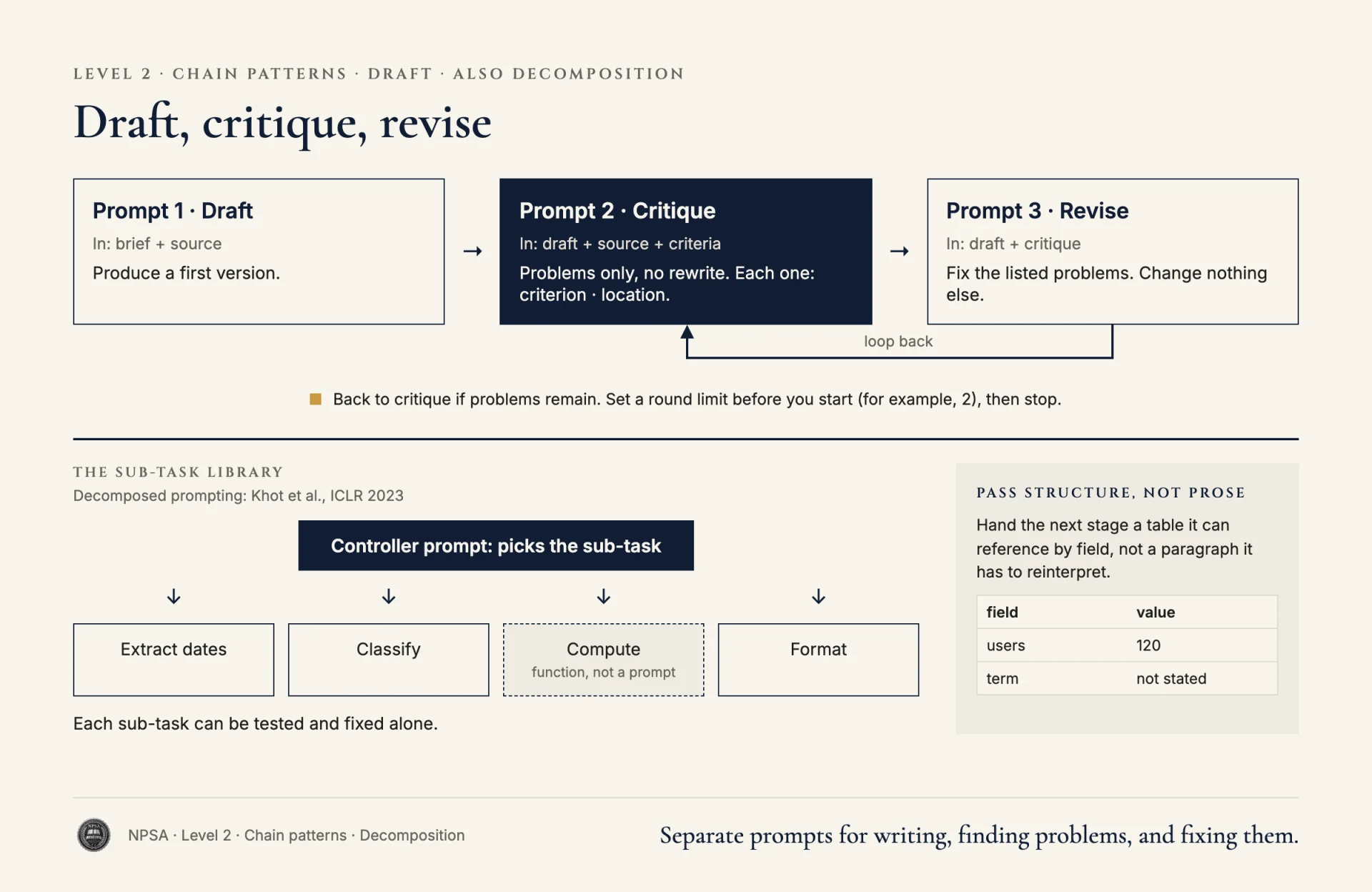
The refine loop. Three prompts, run in order:
- Draft. Produce a first version from the brief and the source.
- Critique. Give a fresh prompt the draft, the source, and a list of specific criteria. Ask only for problems, each tied to a criterion and a place in the draft. No rewriting.
- Revise. Give a third prompt the draft and the critique. Ask it to fix the listed problems and change nothing else.
Why three prompts and not one. Sun and colleagues (2024) compared exactly this on summarization. One version ran draft, critique, and refine as three separate prompts. The other asked for all three steps inside a single prompt. The chained version produced better summaries. The authors suggest the single prompt may produce a simulated refinement: the model writes a critique and a revision that look like a process without the revision truly responding to the critique. Separate prompts force each step to work from what the previous one actually produced.
What makes a critique useful. A critique prompt with no criteria returns generic advice. Give it a checklist drawn from the brief: every figure matches the source, the required items are present, nothing is promised that the source doesn't support, the length limit is met. Ask for "none" where a criterion is satisfied, so a clean result is visible and not just an absence of comments.
A model checking its own draft is not an independent review. The critique step catches mechanical misses against stated criteria. It shares the drafting model's blind spots. Anything consequential still gets a human reviewer.
The sub-task library. Khot and colleagues (2023) proposed treating a complex task as a set of simpler sub-tasks, each handled by its own dedicated prompt, with a controlling prompt that decides which sub-task to call. Their approach outperformed earlier few-shot prompting methods on the tasks they tested. Two features carry over to everyday work:
- Each sub-task prompt can be improved and tested alone. If extraction is weak, you fix the extraction prompt without touching the rest.
- A sub-task doesn't have to be a prompt. In their design, a sub-task could be handed to a trained model or an ordinary function instead.
Ask whether the step needs a model. Arithmetic, sorting, counting, date differences, and looking up a value in a table are done exactly by a spreadsheet or a few lines of code. A model does them approximately. In a chain, give those steps to the exact tool and keep the model for reading, judging, and writing.
When a chain is worth it. Every added prompt adds a call, a delay, and a place to fail. Chain when you need to inspect an intermediate result, when one step's quality is dragging down the whole, or when a test shows the chained version is better. A single clear prompt that passes your checks is the right answer more often than not.
Worked example
Mei-Ling Tan writes member communications for a credit union. The fee schedule changes on March 1, and she needs a one-page plain-language summary for members. Three fees go up, one is removed, and one applies only to business accounts.
Before:
Write a member-friendly summary of the attached fee schedule
changes. Then review your summary for errors and unclear wording,
and give me an improved final version.
All three steps are in one prompt. The "review" and the "improved version" arrive together, and Mei-Ling can't see what the review found or whether the final version addressed it. Nothing says what an error is.
After, prompt 2 of 3 (critique):
Review a draft against its source. Do not rewrite anything.

Check each criterion and report problems only. For each problem,
give the criterion number, the sentence in the draft, and what
the source says. If a criterion has no problems, write "none."

1. Every fee amount and date in the draft matches the source.
2. All five changes in the source appear in the draft.
3. The business-account fee is described as applying only to
   business accounts.
4. Nothing in the draft promises a waiver or exception that the
   source doesn't state.
5. The draft is under 250 words and has no sentence over
   25 words.

<source>
[fee schedule changes]
</source>

<draft>
[output of prompt 1]
</draft>
Prompt 1 asks only for the draft, from the source, under 250 words. Prompt 3 receives the draft and the critique and is told to fix the listed problems and leave every other sentence as it is. The fee amounts in the final version are checked against the schedule by a script that pulls every dollar figure from both and compares them, since exact matching is not a job for a model.
On the first run the critique reports two problems: the draft gave the wire fee as $25 where the source says $28, and it left out the removed paper-statement fee. Criteria 3 to 5 return "none."
Why this is stronger. The critique is a visible list tied to criteria, so Mei-Ling can see what was found and confirm the revision fixed it. The revision works from that list and not from a general urge to improve. The exact comparison of dollar amounts is done by a tool that can't misread. And compliance still reviews the page before it is mailed.
Try it
Setup. Pick a short source and a writing task based on it: a summary of a policy change, a product update, an event notice. Write four or five criteria a good version must meet, at least two of them checkable against the source.
Task. Run the task once as a single prompt that asks for a draft, a self-review, and a final version. Then run it as three prompts, using your criteria in the critique. Compare the two final versions against your criteria.
What a good result looks like. The three-prompt run gives you a critique you can read on its own. You can point to at least one problem it found and confirm the revision fixed it. You can name one step in your task that a spreadsheet or script would do more reliably than a prompt.
Watch for this
- A revise prompt with no limits rewrites good sentences too. Tell it to change only what the critique lists.
- Running the loop again and again gives smaller gains and can introduce new errors. One or two passes, then a person.
- A critique that always returns "none" may have criteria that are too loose. Test it on a draft with a known error.
Recap
- A refine loop is three prompts: draft, critique against criteria, revise from the critique.
- Research on summarization found the three-prompt version beat the same steps in one prompt.
- A model's critique of its own draft is a check, not an independent review.
- Give each sub-task its own prompt so it can be tested and fixed alone.
- Give exact work, such as arithmetic and matching, to an exact tool.
Sources
- Sun, S., Yuan, R., Cao, Z., Li, W., and Liu, P. (2024). "Prompt Chaining or Stepwise Prompt? Refinement in Text Summarization." Findings of ACL 2024. arXiv:2406.00507.
- Khot, T., Trivedi, H., Finlayson, M., Fu, Y., Richardson, K., Clark, P., and Sabharwal, A. (2023). "Decomposed Prompting: A Modular Approach for Solving Complex Tasks." ICLR 2023. arXiv:2210.02406.