Loading lesson…
Long inputs and context limits
25 min read
Current tools accept very long inputs: whole reports, contracts, months of tickets. Accepting a long input and using all of it well are different things. This module covers what research shows about how models handle long contexts, and the working patterns that follow from it: send less, place what matters where it gets used, split long documents into passes you can check, and check whether something in the middle was dropped.
What you will be able to do
- Describe how the position and length of an input affect what a model uses.
- Decide when to send a whole document and when to split it.
- Build a split-and-combine pass with a fixed record for each part.
- Check coverage, so a missing section is caught before the summary ships.
The idea
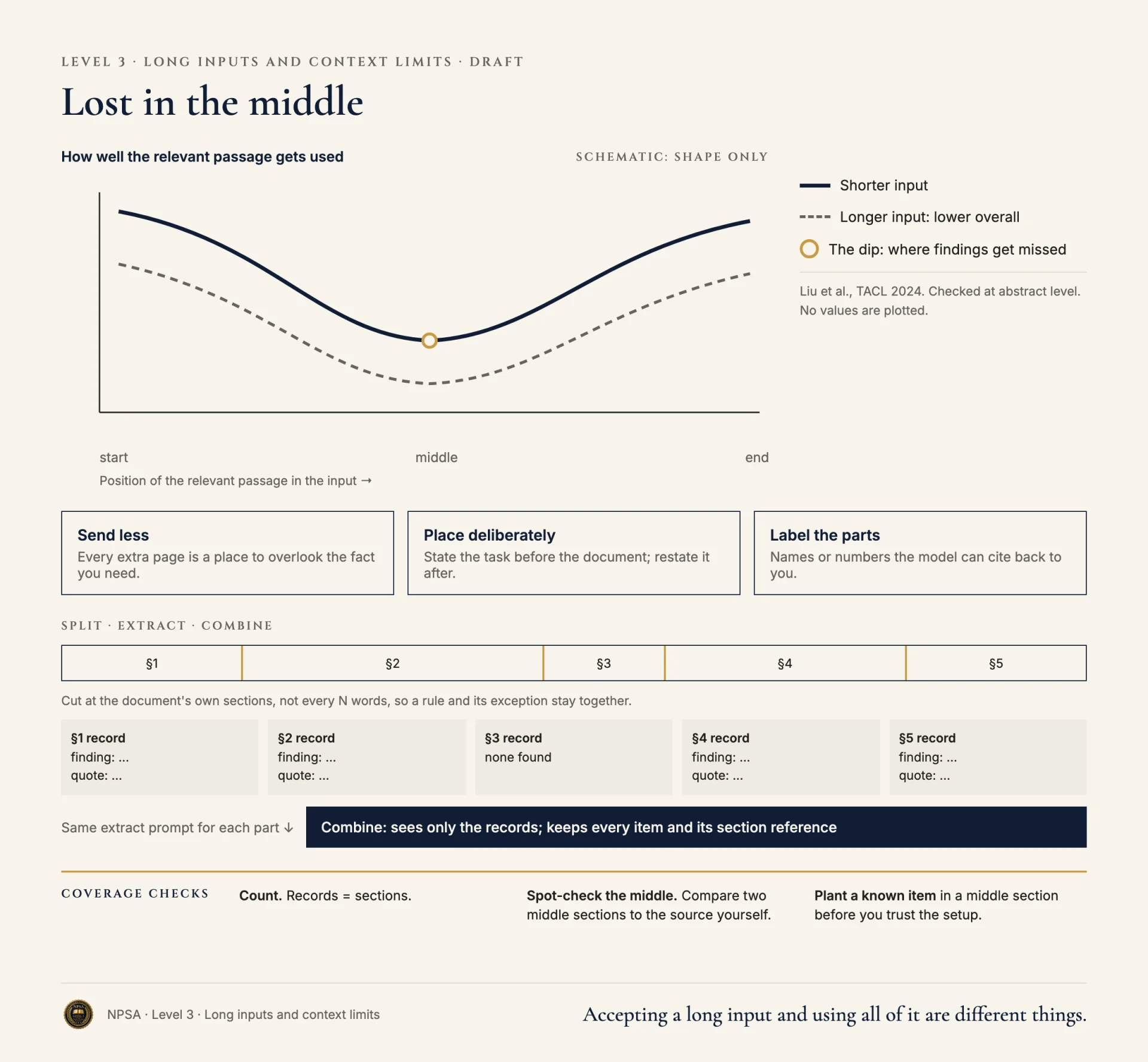
Position matters. Liu and colleagues (2024) gave models a question and a set of documents, one of which held the answer, and moved that document around. Models did best when the relevant document was at the beginning or the end of the input and noticeably worse when it sat in the middle. They also found that performance fell as the input grew longer, including for models built for long contexts.
The models in that study have since been replaced, and the size of the effect varies by model. The working assumption still holds: a long input is not read with even attention, and you should test for misses instead of assuming there are none.
What follows from that.
- Send less. Remove what the task doesn't need. Every extra page is a place for the needed fact to be overlooked.
- Place deliberately. Put the instruction and the question where they are close to the output. With a long document, state the task before the document and restate it briefly after.
- Label the parts. Give sections names or numbers the model can cite, so you can trace each claim back.
Split and combine. When a document is too long to trust in one pass, process it in parts:
- Split along structure. Use the document's own sections, not a fixed number of words, so a rule and its exception stay together.
- Extract from each part with the same prompt into a fixed record: the same named fields every time, with "none found" allowed.
- Combine the records in a final prompt that sees only the records and is told to keep every item and its section reference.
Splitting can reduce long-context omission. It does not guarantee attention, coverage or a correct combination, so extraction and merge failures still have to be checked. Each record can be checked against a few pages.
Always work from the source. Summarizing a summary drops qualifiers such as "pending" and "in most cases." If you need a shorter version, go back to the records or the source, not to the last summary.
Check coverage. A long-document summary fails quietly: it reads well and leaves something out. Three cheap checks:
- Count. The number of records equals the number of sections.
- Spot-check the middle. Pick two sections from the middle of the document and compare the record to the source yourself.
- Plant a known item. Before you trust the setup, confirm it finds a detail you already know is in a middle section.
When one pass is fine. A short document, or a task that needs the gist and not every item, doesn't need this. Splitting adds calls, cost, and a combine step that can fail. Use it when missing one item has a consequence.
Worked example
Ingrid Halvorsen is a safety coordinator at a food packaging plant. An outside auditor delivered a 94-page report in 11 sections. She must give the plant manager a list of every open finding with its deadline.
Before:
Here is our safety audit report. Summarize the key findings and
list anything we need to fix.

[94 pages]
"Key findings" invites the model to choose. Nothing ties a finding to a page, so Ingrid can't check the list without rereading the report. A finding in section 6 could be missing and the summary would read just as well.
After (run once per section):
Extract open findings from one section of a safety audit report.
The section is between the <section> tags.

For each finding the auditor marks as open or unresolved, return:
- section: the section number
- finding_id: the auditor's ID, or "none given"
- finding: one sentence, in the auditor's terms
- deadline: the date stated, or "not stated"
- quote: the sentence that shows it is open

Include every open finding, including minor ones. If the section
has no open findings, return exactly: NO OPEN FINDINGS.
Do not include findings marked closed.

<section number="6">
[section text]
</section>
After (run once, on the 11 records):
Below are records of open findings from 11 sections of a safety
audit. Produce one list for the plant manager, sorted by
deadline, earliest first. Put "not stated" deadlines at the end.

Keep every finding. Do not merge findings, and do not drop any.
Keep the section number and finding_id on every line.
End with a line: TOTAL FINDINGS: N.

[11 records]
Ingrid counts 11 records. She adds up the findings in the records herself and gets 23, which matches the total line. She compares sections 5 and 7 to the report by hand. Section 7's record missed a finding that the auditor described as "remains outstanding," so she adds that phrase to the extraction prompt and reruns the section. She then reruns the combine step: the total line now reads 24, and her hand count agrees.
Why this is stronger. Each pass reads a few pages, which can reduce long-context omission. Extraction and the merge still need checking. Every item has a section and a quote, so checking takes minutes. "NO OPEN FINDINGS" makes an empty section different from a skipped one. The total line and the hand count catch a dropped item, and the middle spot-check found a real miss.
Try it
Setup. Take a document of at least 15 pages with clear sections: a handbook, a long report, meeting minutes from several months. Pick one specific detail from a middle section and write it down.
Task. Ask for a list of all items of one kind (action items, deadlines, requirements) in a single pass. Then do it by section with a fixed record and a combine step. Compare the two lists, and check whether each one found your planted detail.
What a good result looks like. You can say how many items each approach found and which ones differed. The by-section list carries a section reference on every item. You ran the count check and one middle spot-check.
Watch for this
- Splitting by word count can cut a rule from its exception. Split on headings.
- A combine step can silently merge or drop items. Require a total and check it.
- Cross-references ("see section 9") break when sections are read alone. Have the extraction record them as open questions.
Recap
- Models use the start and end of a long input better than the middle, and performance falls as inputs grow.
- Send less, state the task before and after a long document, and label sections.
- For long documents where a miss matters, extract by section into fixed records, then combine.
- Summarize from the source or the records, never from an earlier summary.
- Check coverage: count, spot-check the middle, plant a known item.
Sources
- Liu, N. F., Lin, K., Hewitt, J., Paranjape, A., Bevilacqua, M., Petroni, F., and Liang, P. (2024). "Lost in the Middle: How Language Models Use Long Contexts." Transactions of the Association for Computational Linguistics, 12, 157-173. doi:10.1162/tacl_a_00638.